



I’ve beforehand reviewed the Aircove Go and ExpressVPN Aircove. The Aircove Go was a rebranded GL.iNet router however with a closely modified person interface that restricted numerous the unique performance, basically making it solely potential to make use of ExpressVPN.
They had been good routers and the ExpressVPN firmware made them very simple to make use of however the lack of flexibility with VPNs restricted their attraction significantly, for my part.
ExpressVPN and now again with the Fortify, which is a rebranded model of the GL.iNet’s Flint 2.
Nevertheless, issues are slightly totally different this time round. The firmware continues to be customised for ExpressVPN, however the modifications are rather more restricted and also you get nearly all of the performance of the GL.iNet Flint 2.
I’ve beforehand reviewed the GL.iNet Flint 3 and thought it was very good, in all probability my favorite shopper router. The Flint 2 is generally the identical functionality-wise, however with lower-spec {hardware}.
Specification
| Specification | Fortify (GL-MT6000) |
|---|---|
| Interface | 1 x 2.5G WAN Ethernet Port, 1 x 2.5G WAN/LAN Ethernet Port, 4 x LAN Ethernet Ports, 1 x USB 3.0 Port, 1 x Reset Button |
| CPU | MediaTek Quad-core Processor, @2.0 GHz |
| Reminiscence / Storage | DDR4 1 GB / eMMC 8 GB |
| Protocol | IEEE 802.11a/b/g/n/ac/ax |
| Wi-Fi Velocity | 2.4 GHz: as much as 1148 Mbps; 5 GHz: as much as 4804 Mbps |
| Ethernet Velocity | 2 x 2.5G Ports: 10/100/1000/2500 Mbps; 4 x 1G Ports: 10/100/1000 Mbps |
| Antennas | 4 x 2.4 GHz + 5 GHz two-in-one Wi-Fi Antennas |
| LEDs | 1 x Twin-colour LED Indicator for Energy and Web |
| Energy Enter | DC5521, 12V/4A (5.5 x 2.1 mm) |
| Energy Consumption | <20W |
| Working Temperature | 0°C to 40°C |
| Storage Temperature | -20°C to 70°C |
| Dimension / Weight | 233 x 137 x 53 mm / 761 g |
| Quoted VPN velocity | WireGuard as much as 900 Mbps; OpenVPN DCO as much as 880 Mbps |
| Included VPN plan | 12 months of ExpressVPN Superior for brand new and returning prospects |
The processor is the MediaTek Filogic 830, which is similar chip used within the Flint 2. In comparison with the unique Aircove, which had a 1.2 GHz quad-core CPU, 512 MB of RAM and 128 MB of flash storage, it is a substantial {hardware} improve. The Aircove was additionally restricted to 80 MHz channels on 5 GHz and gigabit Ethernet all through, whereas the Fortify helps 160 MHz channels, 4×4 MIMO on 5 GHz and has two 2.5GbE ports.
Unboxing / Design
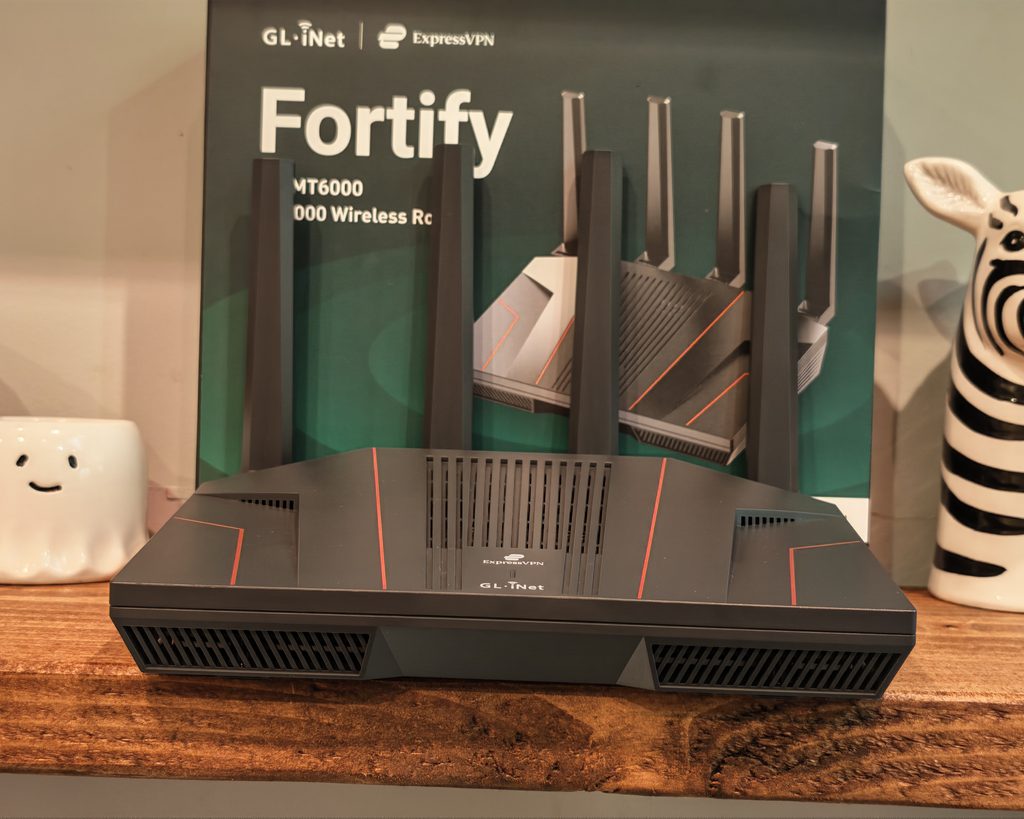
So far as I can inform, the {hardware} is equivalent to the Flint 2. The one visible variations are the ExpressVPN brand subsequent to the GL.iNet brand on the highest panel and skinny purple accent traces throughout the casing. The packaging is labelled as a restricted version and is co-branded, with the 12-month ExpressVPN Superior subscription highlighted on the entrance.
Contained in the field, you get the router, a 12V/4A energy adaptor, an Ethernet cable and the standard documentation.
The router has a matte black, angular design with a big ventilated part on prime and vents alongside the entrance and sides. It seems like networking gear relatively than a life-style product, so it fits a desk, shelf or cabinet greater than a front room. The 4 antennas are completely hooked up however hinge so you’ll be able to angle them or fold them flat.
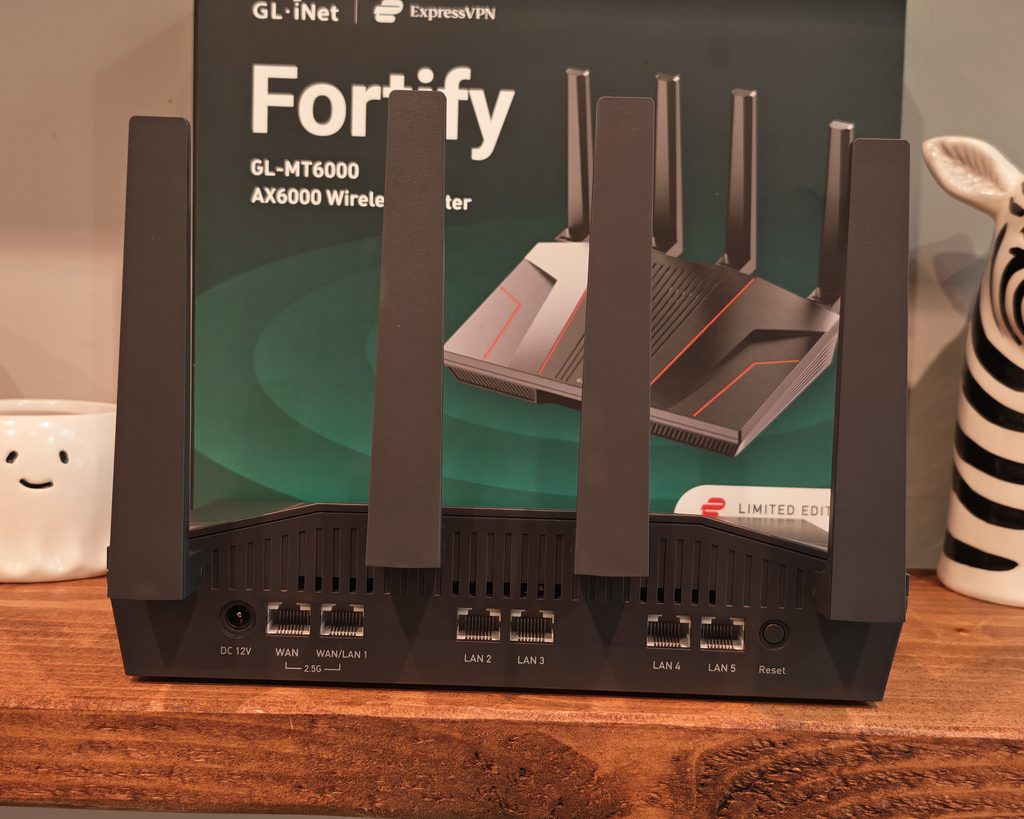
On the rear, you’ve got the DC enter, the two.5GbE WAN port, the two.5GbE WAN/LAN1 port, 4 gigabit LAN ports and the reset button. The only USB 3.0 port is on the aspect, which makes it simpler to plug in a USB drive or a 4G/5G dongle with out reaching across the again. There’s a single LED on the entrance for energy and web standing relatively than an array of port lights, which I desire.


My essential criticism of the port structure is that solely two ports are 2.5GbE, and a type of is the WAN. When you have a multi-gig web connection, that leaves one 2.5GbE port for a NAS or desktop, with every part else on gigabit. The Flint 3 has 5 2.5GbE ports, which is likely one of the causes it prices extra.
Set Up
Organising the Fortify is similar as another GL.iNet router. You connect with the default Wi-Fi community utilizing the credentials on the label beneath, or through Ethernet, then browse to 192.168.8.1. The wizard asks you to decide on a language and set an admin password, after which you land on the principle dashboard. There’s additionally the GL.iNet smartphone app for those who desire, however I discover the online interface faster and extra full.
My Aquiss connection on CityFibre makes use of PPPoE, so I chosen that choice on the Web web page and entered my username and password. The router linked immediately. DHCP and static IP are additionally supported, as are repeater mode, USB tethering and USB 4G/5G modems, which I cowl beneath.
It’s value checking for a firmware replace immediately. My unit was working firmware v4.9.0, which is the present GL.iNet firmware department.
The ExpressVPN activation is a part of the VPN part relatively than the preliminary set-up wizard. That could be a smart change from the Aircove, which pushed you into ExpressVPN from the beginning. With the Fortify, you will get the router working first after which determine whether or not you need to activate the subscription.
There are two cloud providers listed within the menu. GoodCloud is GL.iNet’s distant administration platform, which helps you to view and handle the router from wherever. AstroWarp is GL.iNet’s newer networking service for linking websites and units. Each are optionally available, and I left them disabled, as I desire Tailscale for distant entry.
Settings and Options
The interface is the usual GL.iNet admin panel, with menus for Web, Wi-fi, Shoppers, Cloud Companies, VPN, Community, Move Management, Safety, Purposes and System. Pages load rapidly, and the structure is way simpler to navigate than the LuCI interface beneath.
The Wi-fi web page helps you to arrange three separate community teams: Primary, Visitor and IoT. Every one has its personal SSIDs for two.4 GHz and 5 GHz and its personal subnet, so you’ll be able to preserve sensible residence units away out of your computer systems and NAS without having to know VLANs. Every SSID can have its personal safety mode, transmit energy and wi-fi settings. For a shopper router, it is a higher method than most manufacturers, which generally provide a visitor community and nothing else.
One factor I observed is that the default safety mode is WPA2-PSK. I might change the principle community to WPA2/WPA3 combined mode in order that fashionable units use WPA3 whereas older units can nonetheless join. I might additionally depart the IoT community on WPA2 and a couple of.4 GHz for compatibility, which is what GL.iNet recommends on the web page.
The Shoppers web page lists linked units, with choices to order an IP handle, block a tool or set velocity limits. My one gripe is system identification. Units seem by hostname and MAC handle, and my desktop confirmed up twice beneath the identical identify, as soon as for the wired connection and as soon as for the wi-fi one. On a community with dozens of sensible residence units, this will get messy rapidly.
Below Community, you’ve got the multi-WAN choices. The second 2.5GbE port can be utilized as a further WAN, and you may also use USB tethering, a USB 4G/5G modem or a repeater connection to a different Wi-Fi community. These may be arrange for failover or load balancing. I take advantage of a 5G router as failover on my essential UniFi community, and having this constructed right into a sub-£200 shopper router is beneficial for anybody working from residence on an unreliable connection.
Different choices embrace IPv6, port forwarding, DMZ, DNS settings with DNS over HTTPS and DNS over TLS, community acceleration, and drop-in gateway mode. Drop-in gateway mode helps you to place the Fortify behind your present ISP router and deal with VPN and AdGuard House for chosen units, with out changing the principle router.
VPN Efficiency & Coverage Based mostly Routing
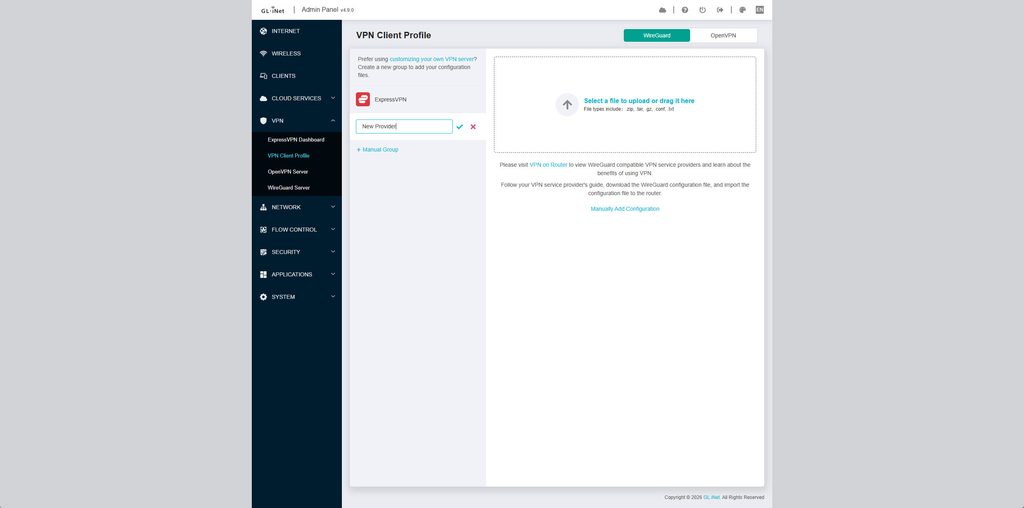
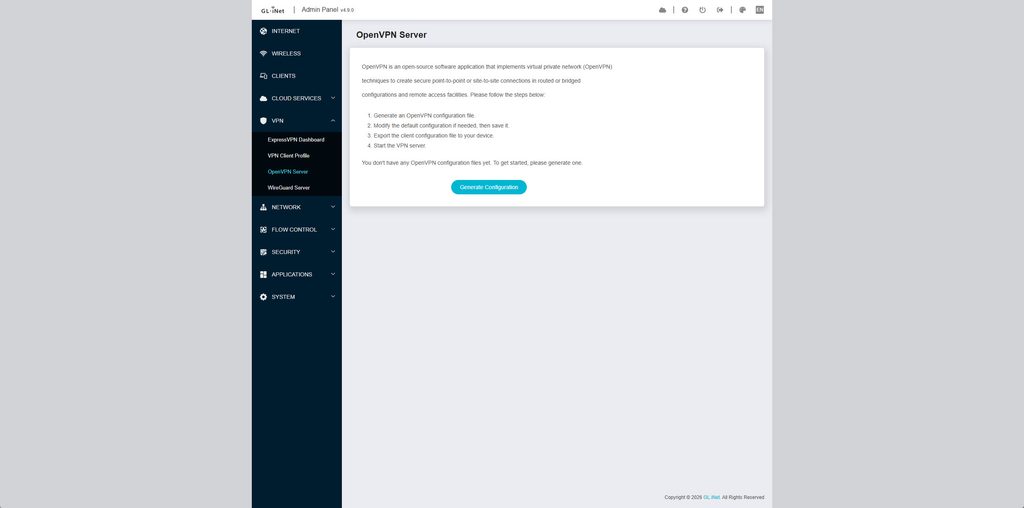
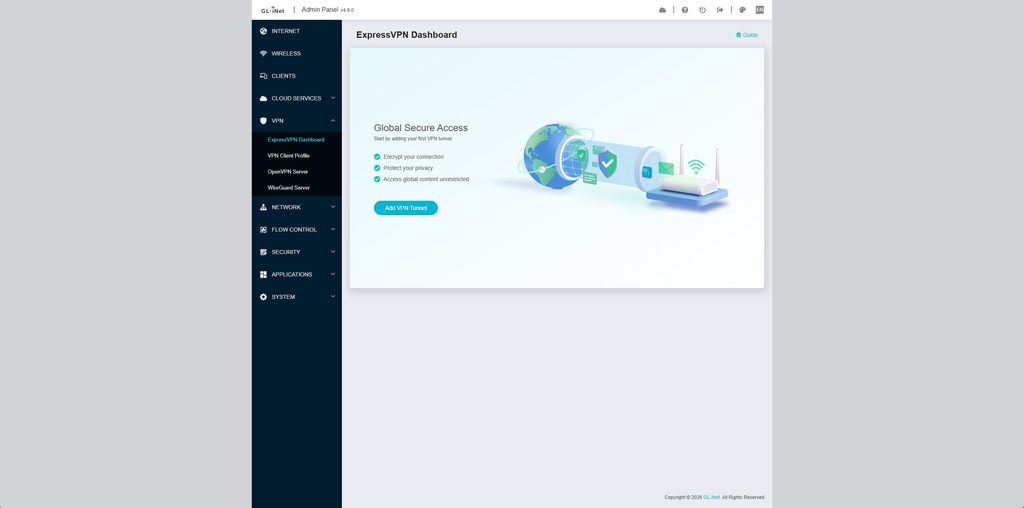
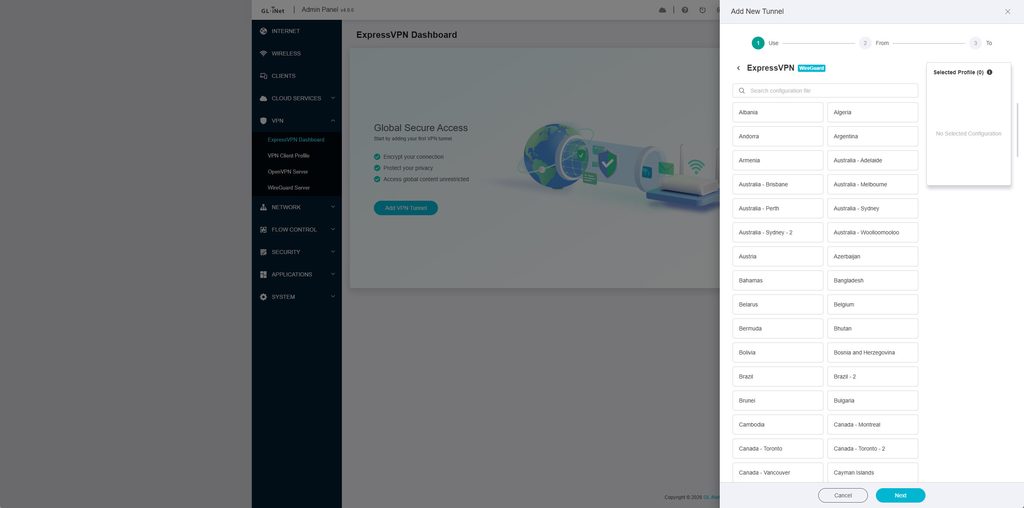
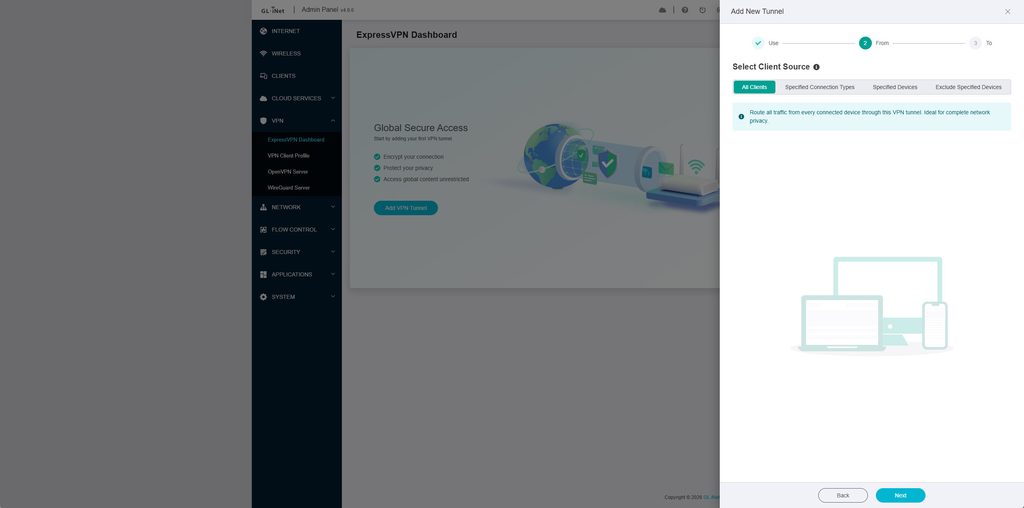
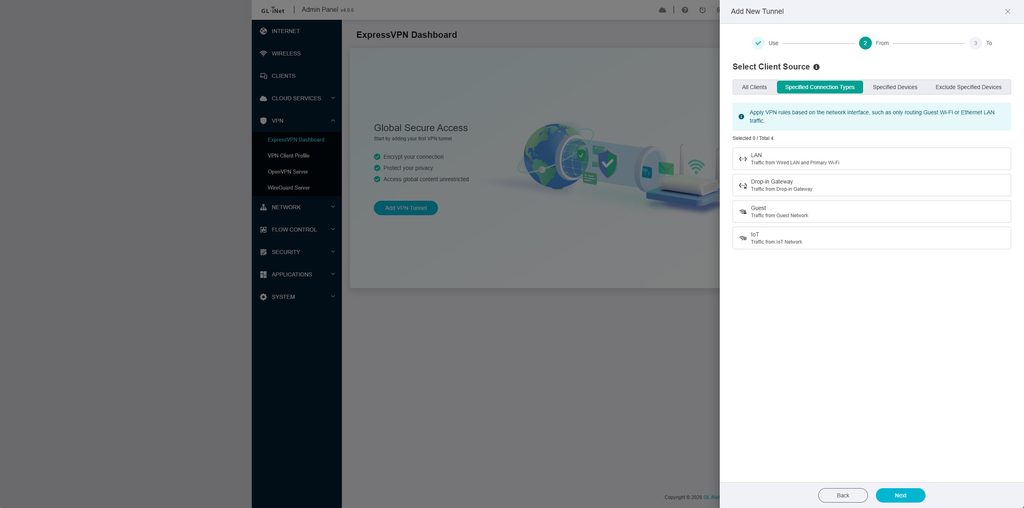
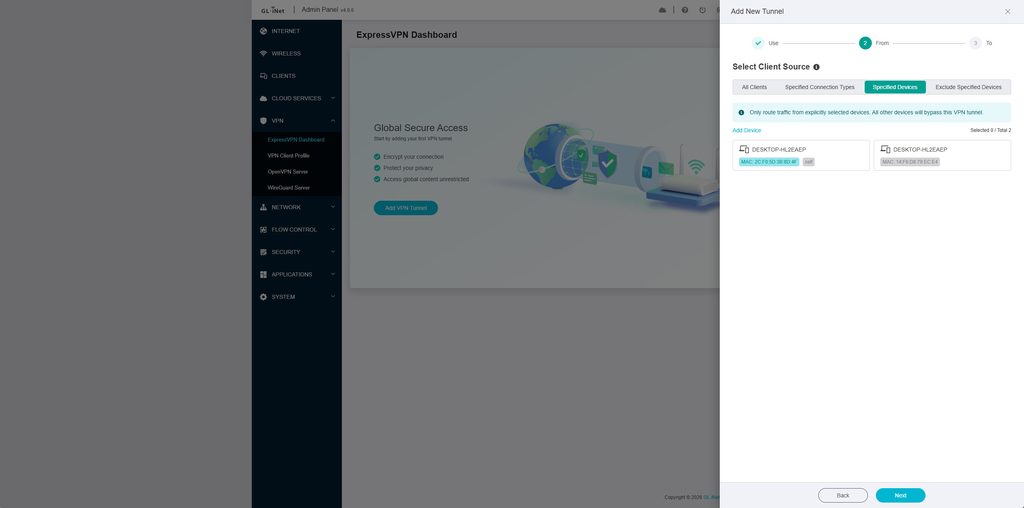
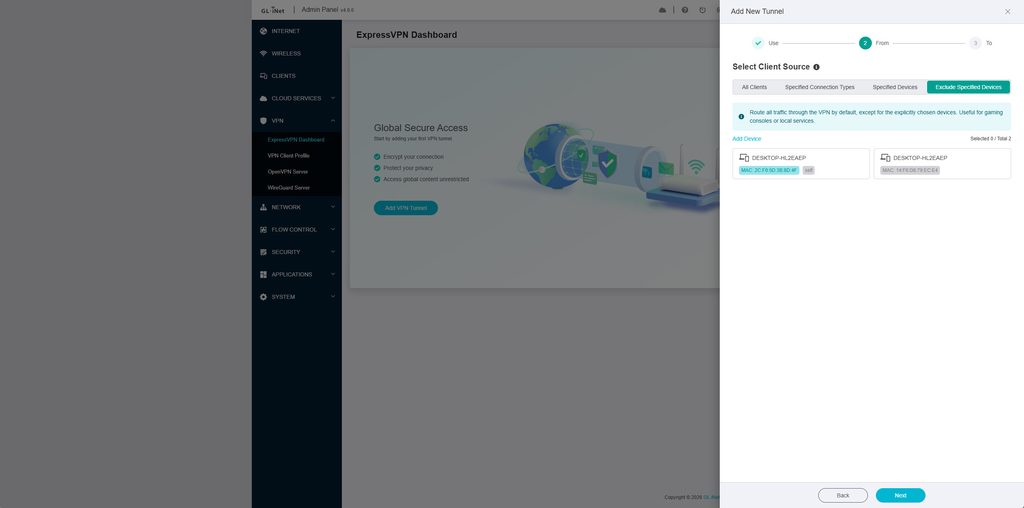
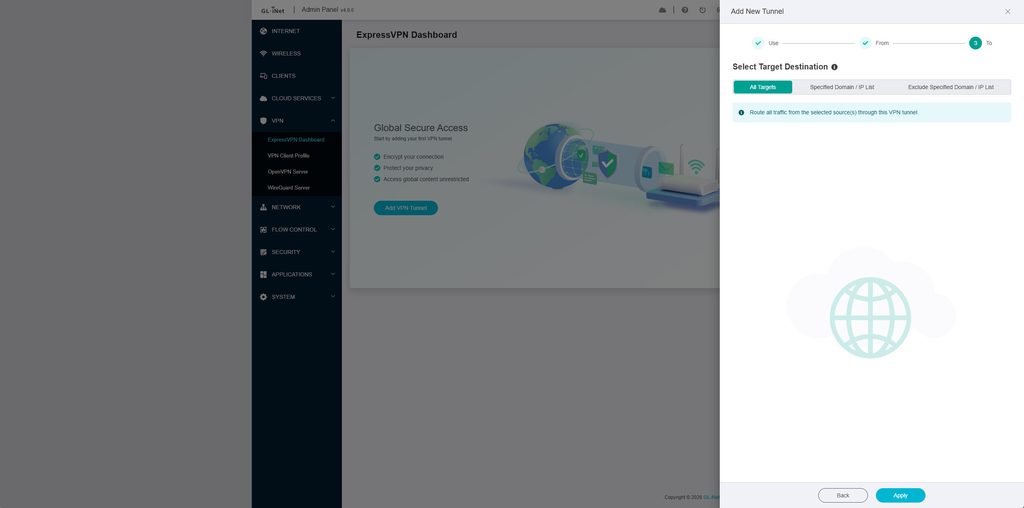
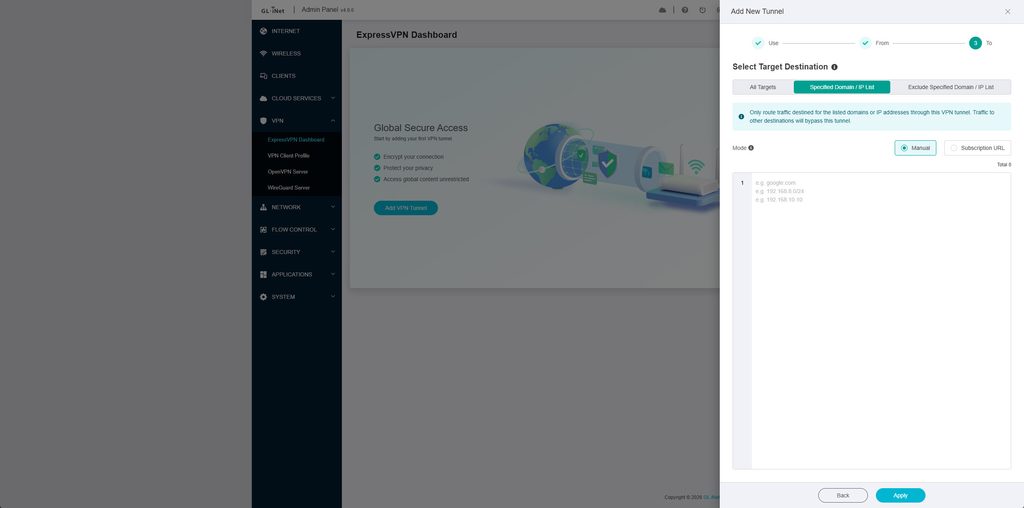
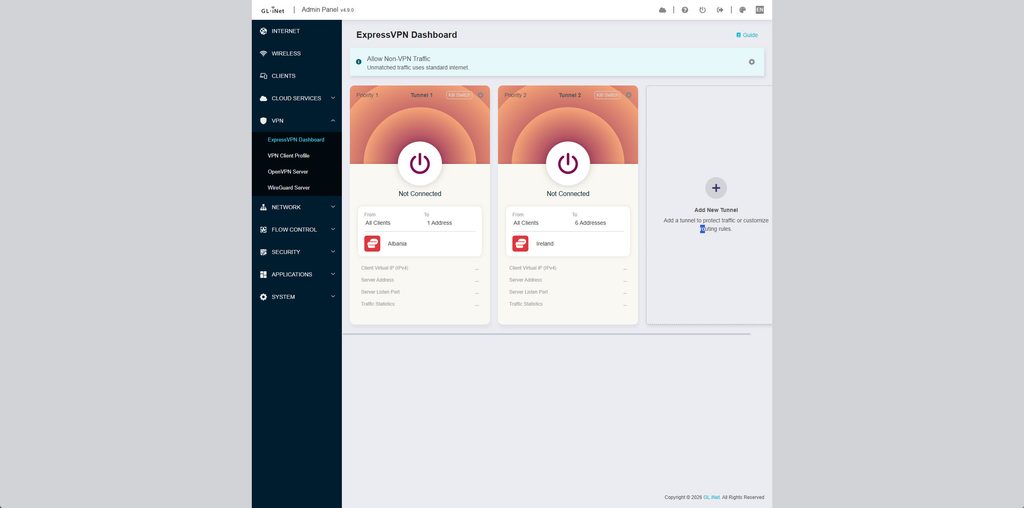
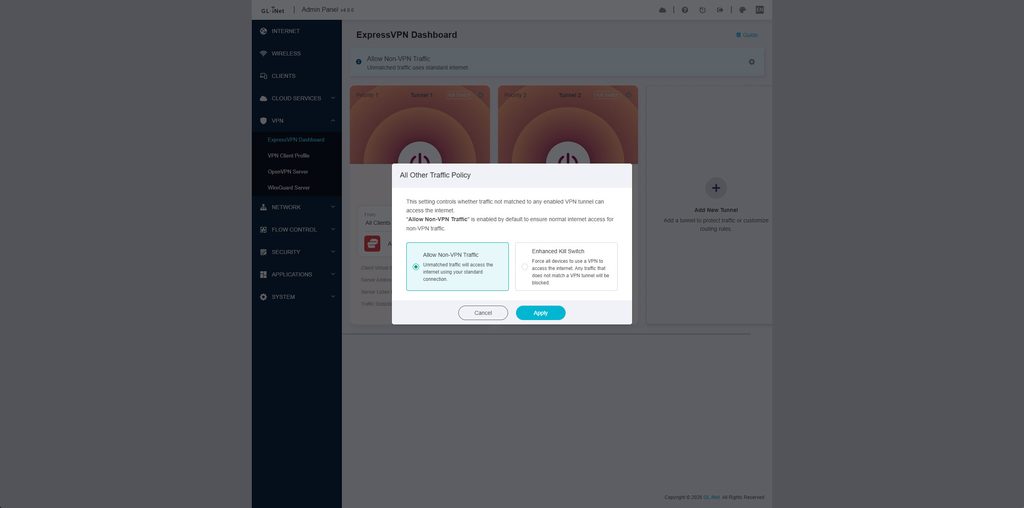
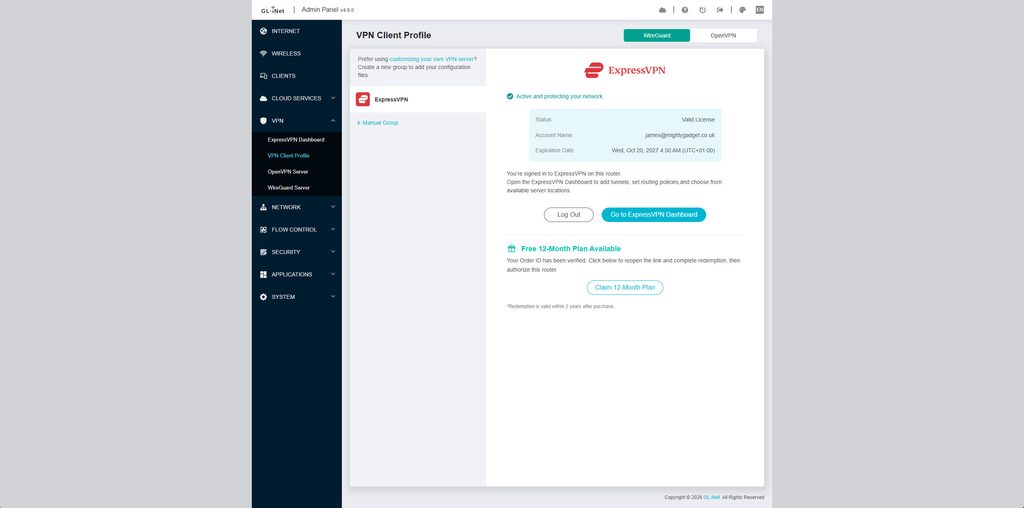
The VPN part of the router is the principle factor that differs between the Fortify and Flint 2, and it’s a comparatively small change.
Mainly, while you go to the VPN Consumer Profile, there is just one pre-defined choice, and that’s for ExpressVPN. From this, you’ll be able to log in to your VPN account and declare your 12-month plan. To get the plan, you have to to offer a purchase order order from both Amazon or GL.iNet. Additionally, you will have to undergo the checkout course of on ExpressVPN and supply a working fee methodology, although no cash shall be taken. When you have no intention of renewing, you’ll be able to cancel the account immediately, the place additionally, you will be provided 3 further months totally free.
The plan included is ExpressVPN Superior. In addition to the VPN, this consists of the ExpressKeys password supervisor and a personal electronic mail relay for masking your electronic mail handle when signing up for providers. These options dwell within the ExpressVPN apps in your telephone and laptop relatively than on the router.
With ExpressVPN arrange, you’ll be able to go to the ExpressVPN Dashboard and arrange tunnels. That is an incredible function of GL.iNet routers and the ExpressVPN branded fashions. Fairly than sending all site visitors by means of the VPN, you’ll be able to arrange guidelines based mostly on connection kind or units, or ignore particular units. You may then outline targets which might be both area or IP based mostly.
The rule-based system is one thing that has turn into more and more essential over the previous couple of years, as you need to use it to bypass the ridiculous ID checks which have been launched as a part of the On-line Security Act. I merely don’t belief web sites, or the third-party ID suppliers, to retailer id information securely, and that lack of belief has already been justified with the Discord hack, which uncovered 70,000 Discord customers’ ID photographs.
Sadly, the On-line Security Act causes plenty of legitimate web sites to require ID checks. Reddit is an efficient instance. My associate was frequently being blocked from a real crime subreddit, and I used to be blocked from the UK medical hashish subreddit. So, I now run all Reddit site visitors by means of an Irish VPN server utilizing the rule-based insurance policies on the Fortify, which has labored nice.
One other widespread choice is to run YouTube by means of explicit international locations, comparable to Albania or Andorra, to keep away from adverts.
Below the VPN Consumer Profile, you’ll be able to import different VPN profiles, both manually or utilizing a conf file out of your VPN supplier. As a check, I exported a WireGuard profile from Surfshark utilizing an Irish server.
With the Surfshark profile put in, I might go to the ExpressVPN Dashboard and create a brand new tunnel utilizing Surfshark as an alternative. Aside from that, all of the settings are equivalent to the ExpressVPN settings.
That is the most important change from the Aircove and Aircove Go. Each had been locked to ExpressVPN, and I mentioned in each evaluations that the choice so as to add different suppliers would make them much more interesting. The Fortify does precisely that. The one factor you lose in comparison with a GL.iNet branded router is the checklist of pre-configured suppliers, which saves a couple of minutes of downloading config information.
Protocols and speeds
At launch, the Fortify connects to ExpressVPN utilizing WireGuard. The Aircove used ExpressVPN’s personal Lightway protocol, together with OpenVPN and IKEv2. In my Aircove testing, IKEv2 was the quickest choice, however WireGuard is mostly quicker and extra environment friendly than all of these on router {hardware}, so I don’t see the change as a loss.
GL.iNet quotes as much as 900 Mbps for WireGuard and as much as 880 Mbps for OpenVPN with DCO acceleration. These figures are based mostly on the router’s {hardware} functionality beneath managed circumstances, so real-world speeds by means of a industrial VPN server shall be decrease and can rely upon the server location, its load and your individual connection.
Even so, the advance over the Aircove is critical. ExpressVPN quoted as much as 180 Mbps for the Aircove, and one of the best I achieved was 257 Mbps to a UK server utilizing IKEv2, with Lightway UDP managing simply 120 Mbps. The Fortify has round 3 times the processing headroom, so it’s far much less more likely to be the bottleneck on a typical 500 Mbps or gigabit FTTP connection. For my Reddit site visitors through Eire, I’ve not observed any slowdown in comparison with searching with out the VPN.
Kill change and different VPN choices
The VPN Dashboard additionally consists of the choice to dam non-VPN site visitors, which acts as a kill change. If the tunnel drops, units coated by that rule lose web entry relatively than falling again to your regular connection. That is what you need for privateness, however it may be complicated for those who overlook it’s enabled and the VPN server goes down.
The Fortify can even act as a VPN server utilizing WireGuard or OpenVPN, so you’ll be able to join again to your house community when travelling. Tor is supported too, although speeds are sluggish, as you’d anticipate.
Purposes
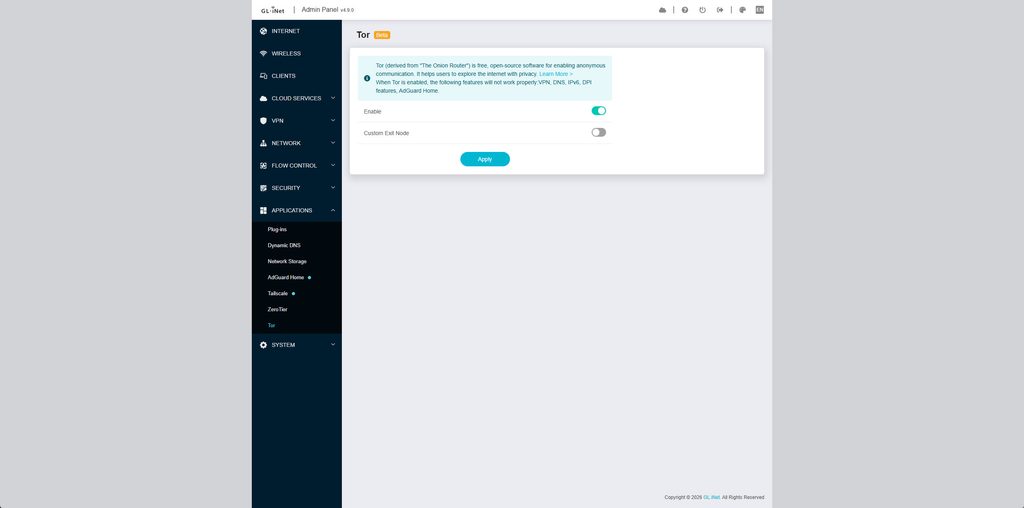
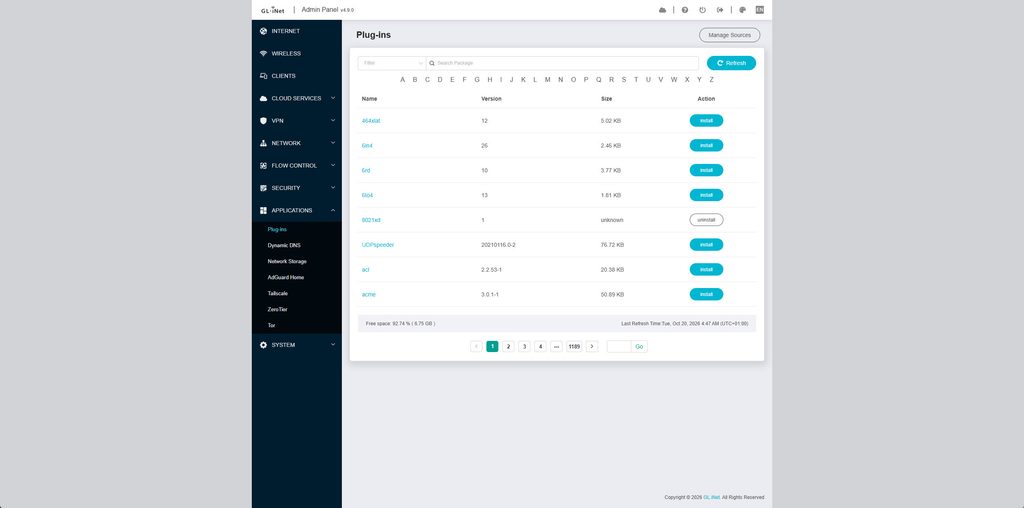
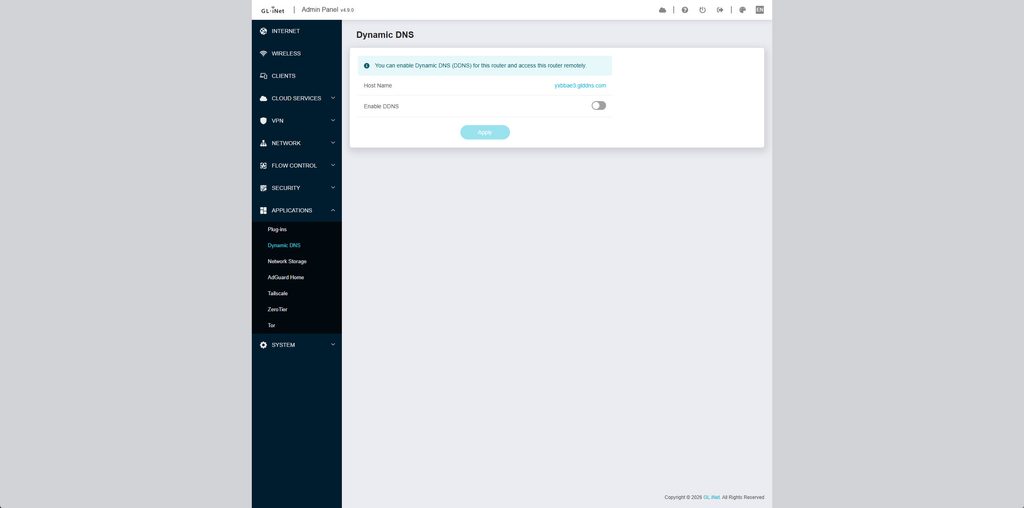
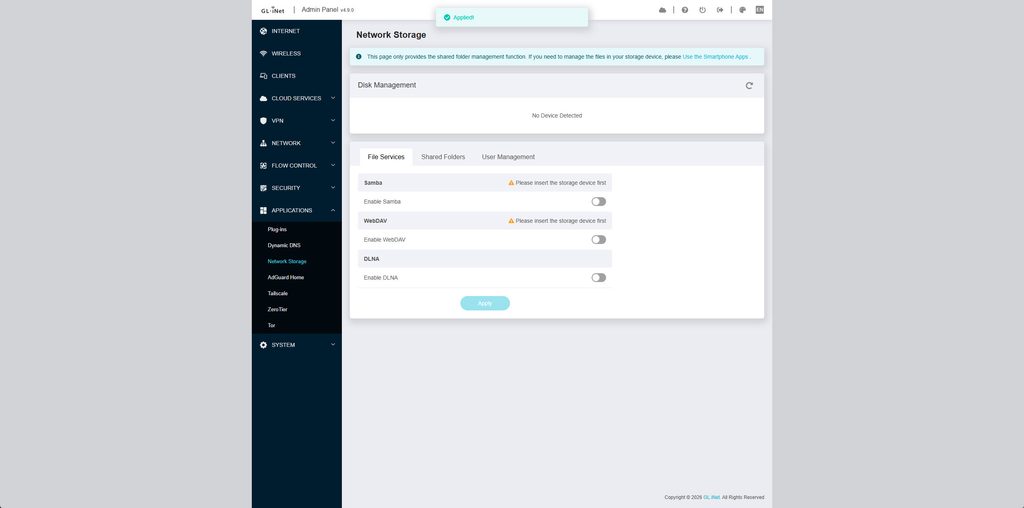
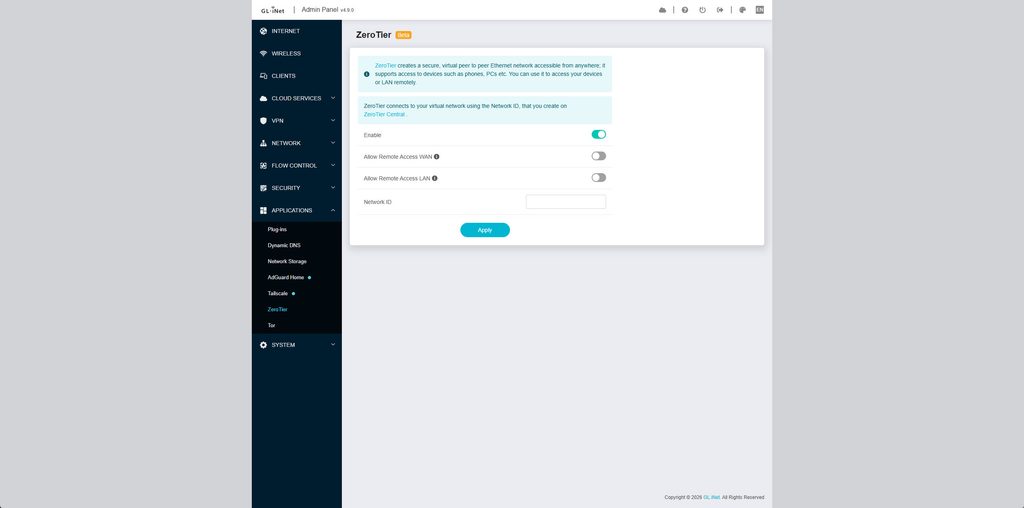
The Purposes menu is the place the Fortify differs most from the Aircove and Aircove Go. These routers stripped the GL.iNet firmware again to a slim set of ExpressVPN options. The Fortify retains the complete GL.iNet software suite, together with AdGuard House and Tailscale, which I cowl beneath, plus a number of different helpful extras.
Plug-ins
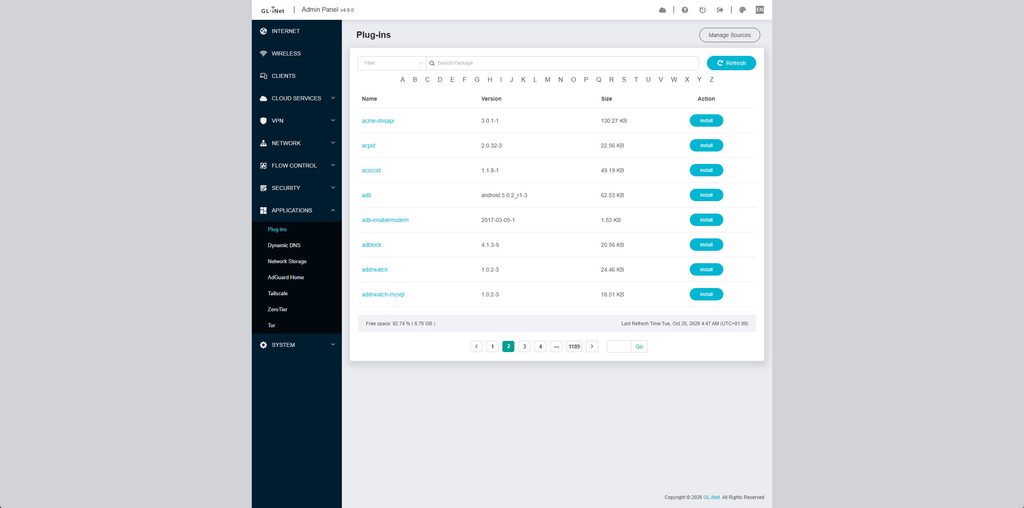
The Plug-ins web page is a entrance finish for the OpenWrt package deal repository, so you’ll be able to set up software program with out going into LuCI or utilizing SSH. There are 1,189 pages of packages at eight per web page, which works out at roughly 9,500 packages. You may search, filter, browse alphabetically and add different repositories through Handle Sources.
The 8 GB of eMMC storage helps right here. My unit reported 6.75 GB (92.74%) free, so area is unlikely to be a limitation. For comparability, the unique Aircove had simply 128 MB of flash storage.
The draw back is that the checklist is a uncooked dump of package deal names with no descriptions. Until you already know that acme handles SSL certificates or that 464xlat is for IPv6 transition, most of it can imply nothing to you. Most individuals won’t ever want this web page, and the extra you put in, the higher the possibility of one thing conflicting with GL.iNet’s personal scripts or a firmware replace. For anybody who does want a particular OpenWrt package deal, although, having it out there from the principle interface is handy.
Dynamic DNS
GL.iNet supplies a free hostname on its glddns.com area, and enabling it’s a single toggle. That is helpful if you wish to attain the router or a port-forwarded service from outdoors your house.
It does require a public IP handle. Some UK alt-nets and most 4G/5G connections use CGNAT, by which case DDNS is not going to work. Even with a public IP, I might relatively not expose a router admin web page to the web, and Tailscale or ZeroTier is a safer strategy to get distant entry.
Community Storage
Plug a drive into the USB 3.0 port and you’ll share it through Samba, WebDAV or DLNA, with separate tabs for shared folders and person accounts. The net interface solely manages the shares, and GL.iNet directs you to its smartphone app for managing information.
It’s superb for sharing a USB drive throughout the community or streaming media to a TV, however I might deal with it as a comfort function relatively than a alternative for a correct NAS.
AdGuard / Adblocking
AdGuard is a superb software for network-wide tracker and advert blocking, and I might say it’s superior to the favored Pi-hole.
With many web sites affected by adverts and browsers like Chrome making ad-blocking more durable, instruments like AdGuard are more and more essential.
It’s not nearly advert blocking both; instruments like this are more and more essential for safety, as they’ll block malicious web sites (and adverts), and you’ll customise the settings to dam apps or apply Protected Search, after which apply these settings to particular purchasers, successfully supplying you with parental management.
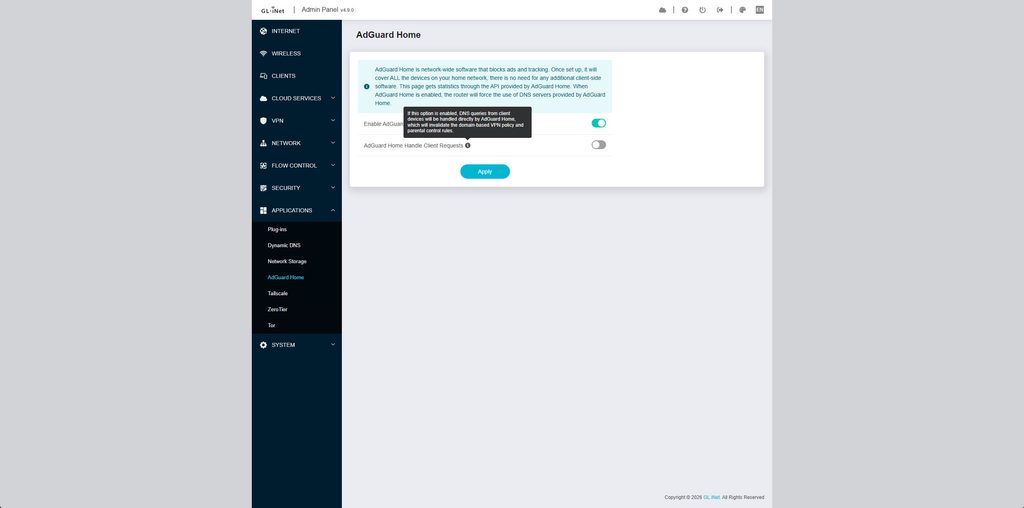
There’s one AdGuard House setting value flagging. The “AdGuard House Deal with Consumer Requests” toggle lets AdGuard reply DNS queries from consumer units immediately. The router warns that enabling it can cease domain-based VPN insurance policies and parental management guidelines from working.
As I route Reddit by means of an Irish VPN server utilizing a domain-based rule, I depart this off. The trade-off is that AdGuard then sees queries coming from the router relatively than particular person units, so per-client AdGuard guidelines, comparable to Protected Search for a kid’s pill, usually are not as efficient. You successfully have to decide on between AdGuard’s per-device controls and the router’s personal domain-based routing and parental controls.
The default settings for this are primary, with the upstream DNS servers set to eight.8.8.8 and 9.9.9.9 after which the default AdGuard block lists. So, it would be best to customise the settings to enhance the advert blocking.
In my expertise, AdGuard is way superior to any native ad-blocking service competing routers provide, together with the ad-blocking inside UniFi. And, not like some choices, there is no such thing as a further value for this.
It is usually significantly better than the advert blocking on the Aircove, which used fastened block lists with no strategy to whitelist domains and let some adverts by means of. With AdGuard House, you’ll be able to add your individual lists, whitelist something that breaks and think about a full question log to see what’s being blocked.
Tailscale / ZeroTier
I’m an enormous fan of Tailscale and like it over conventional VPNs like WireGuard. It’s the good answer for anybody who needs to have the ability to entry their residence community remotely. Whereas I recognize that it’s fairly a distinct segment requirement, there are lots of people who host their very own servers for media or self-hosted providers to switch Google and so on., comparable to Nextcloud, or picture backups with issues like Immich.
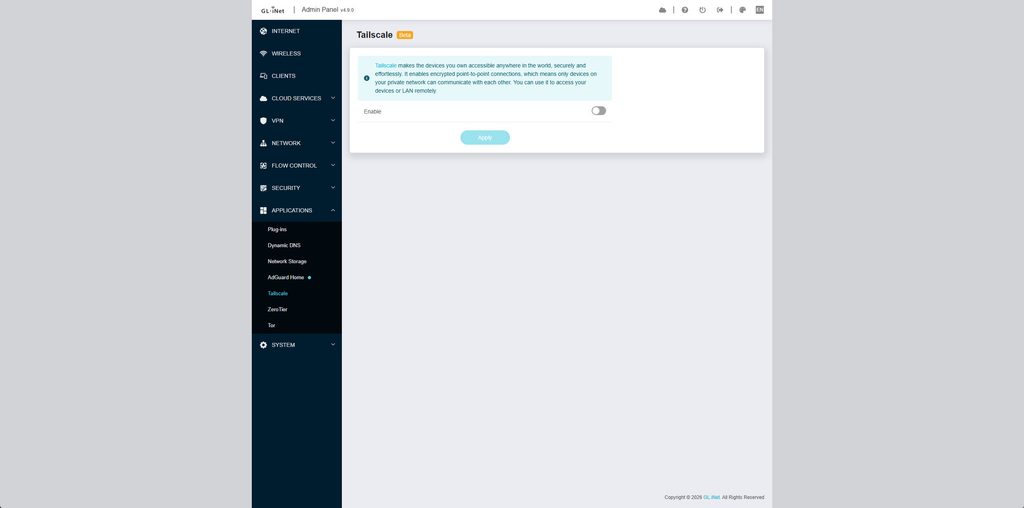
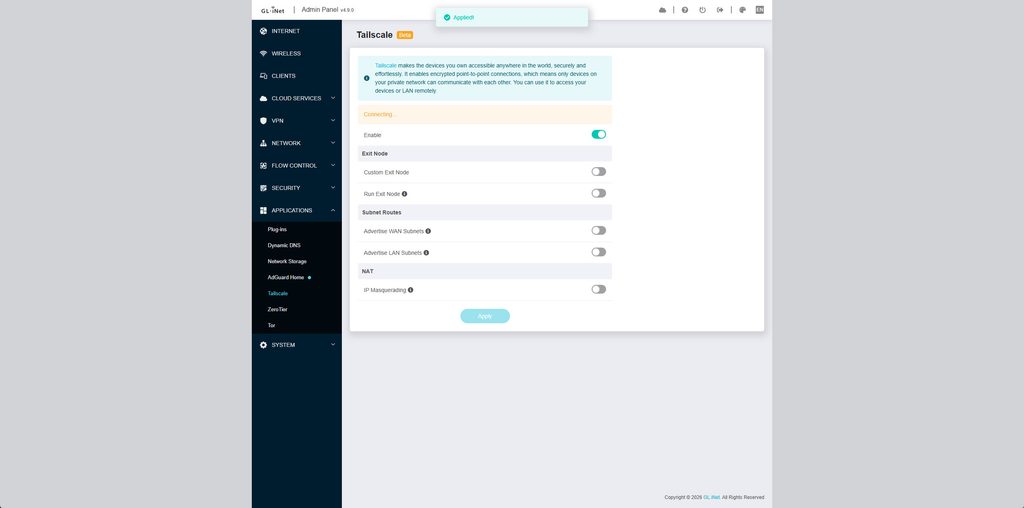
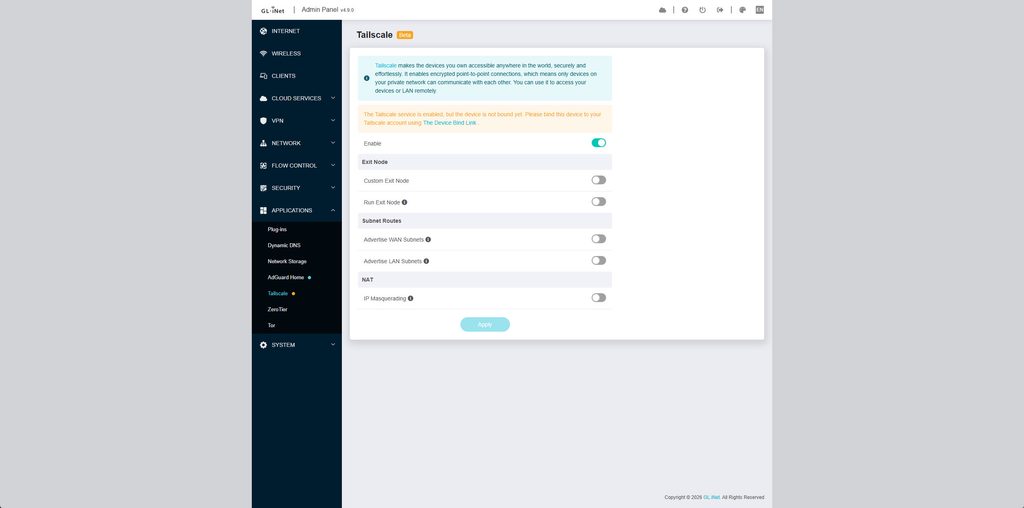
The implementation on this router makes it extraordinarily simple; you simply allow the service, then join your account. You too can set it up as an exit node, the place all of your site visitors runs by means of the router, and use subnet routes so the router can expose your different units on the community. I typically desire to put in Tailscale on every service I entry, however the subnet choice does make life simpler.
GL.iNet nonetheless labels Tailscale as beta, and it warns that working it concurrently one other VPN consumer may cause routing conflicts. Should you plan to make use of ExpressVPN tunnels and Tailscale collectively, it’s value testing that each behave as anticipated earlier than counting on them.
Alternatively, you need to use ZeroTier, which creates a safe, digital peer-to-peer Ethernet community accessible from wherever. I’ve solely dabbled with this as I desire Tailscale.
Move and Parental Management
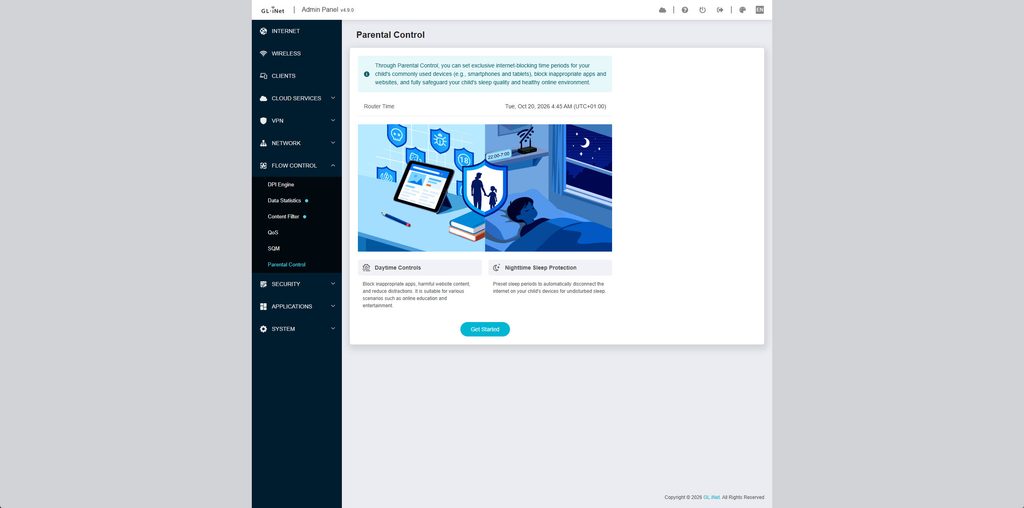
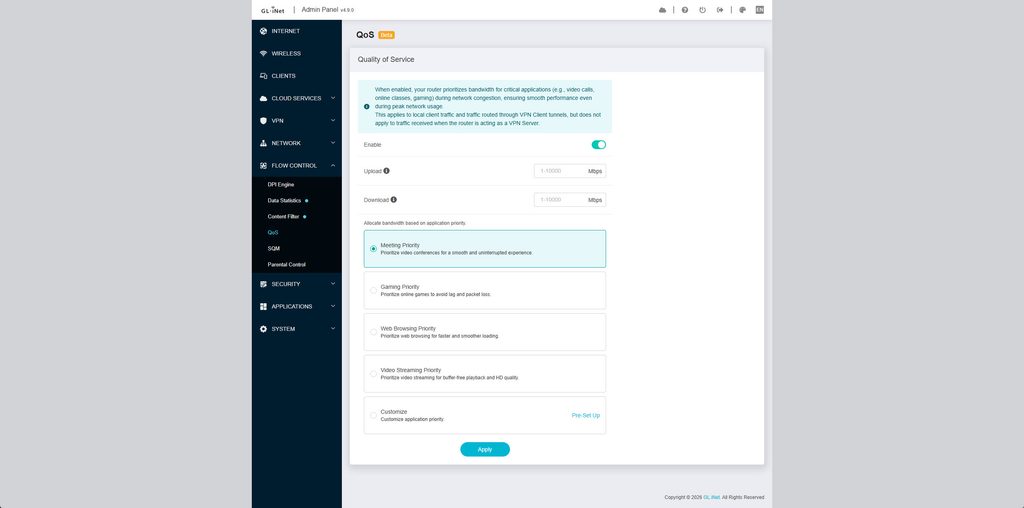
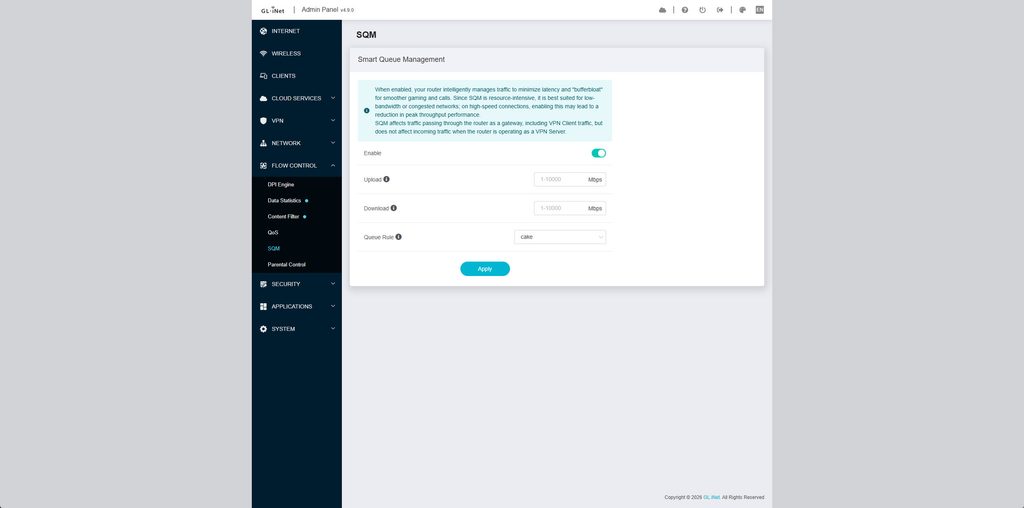
The Move Management menu teams GL.iNet’s site visitors administration instruments: the DPI Engine, Knowledge Statistics, Content material Filter, QoS, SQM and Parental Management. A number of are labelled as beta, however in my expertise they labored as described.
DPI Engine
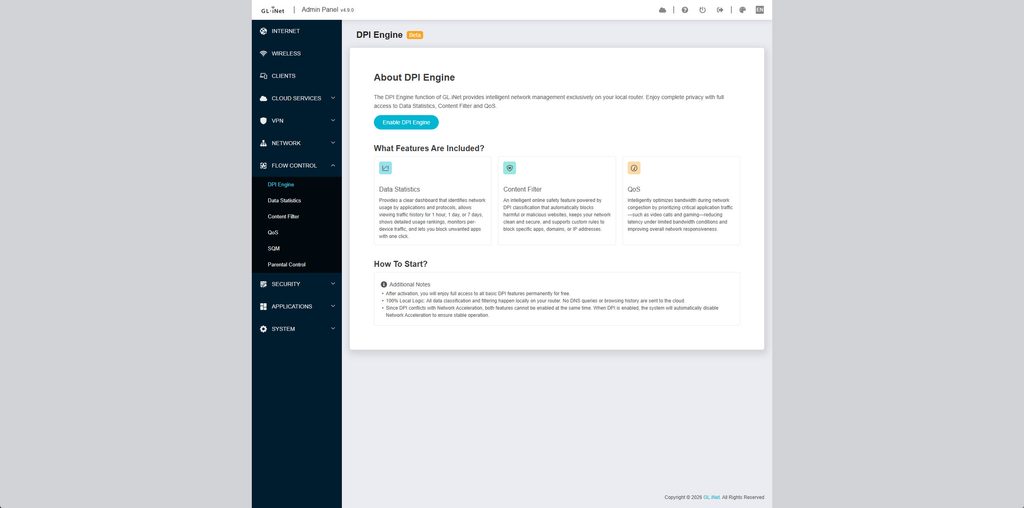
Many of the options on this part rely upon the DPI (Deep Packet Inspection) Engine, which that you must allow first. DPI identifies site visitors by software relatively than simply IP handle and port, which is what permits the router to recognise Spotify or WhatsApp site visitors and deal with it in another way.
GL.iNet states that each one classification occurs domestically on the router, with no DNS queries or searching historical past despatched to the cloud, and that the essential DPI options are free completely. That compares favourably with TP-Hyperlink HomeShield Professional and Netgear Armor, which cost a subscription for related options and depend on cloud providers.
The principle caveat is that DPI conflicts with Community Acceleration, so enabling it mechanically disables {hardware} acceleration. With acceleration off, the CPU has to course of each packet. On a typical 500 Mbps connection that is unlikely to matter, however if you’re on a multi-gigabit FTTP line, it’s value working a velocity check earlier than and after enabling it.
Knowledge Statistics
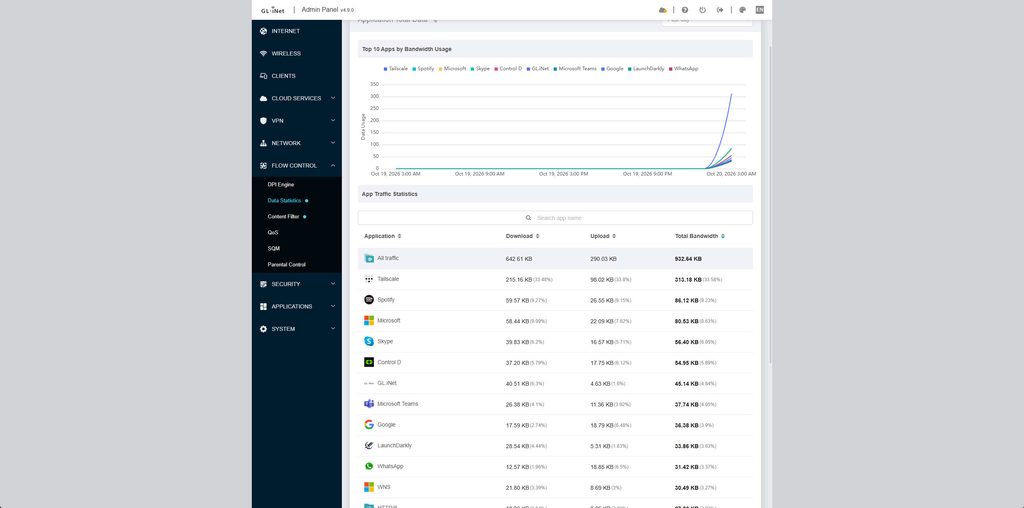
Knowledge Statistics supplies a dashboard exhibiting the highest 10 purposes by bandwidth, with historical past for the previous hour, day or week, utilization rankings and per-device site visitors. You too can block an software with one click on.
The identification is extra granular than I anticipated. After a brief interval, it had appropriately picked out Tailscale, Spotify, Microsoft Groups, Skype, WhatsApp and Management D, in addition to LaunchDarkly, a feature-flag service that many apps use within the background. It’s much like the site visitors identification on my UniFi Cloud Gateway Max, which is spectacular for a router at this worth.
The weak spot is system identification. Shoppers are listed by hostname and MAC handle, and my desktop appeared twice beneath the identical identify (as soon as wired and as soon as wi-fi). On a busy community, this makes per-device statistics more durable to interpret than they need to be.
Content material Filter
The Content material Filter makes use of DPI classification to dam malicious and dangerous web sites network-wide, and you’ll add customized guidelines to dam particular apps, domains or IP addresses.
There’s some overlap with AdGuard House, however the method is totally different. AdGuard filters on the DNS stage, which a tool can bypass with DNS over HTTPS or a hardcoded DNS server. DPI-based filtering inspects the site visitors itself, so in precept it’s more durable to work round.
QoS
QoS (High quality of Service) prioritises sure sorts of site visitors when your connection is congested. You enter your add and obtain speeds, then select from presets for Assembly, Gaming, Internet Shopping or Video Streaming precedence.
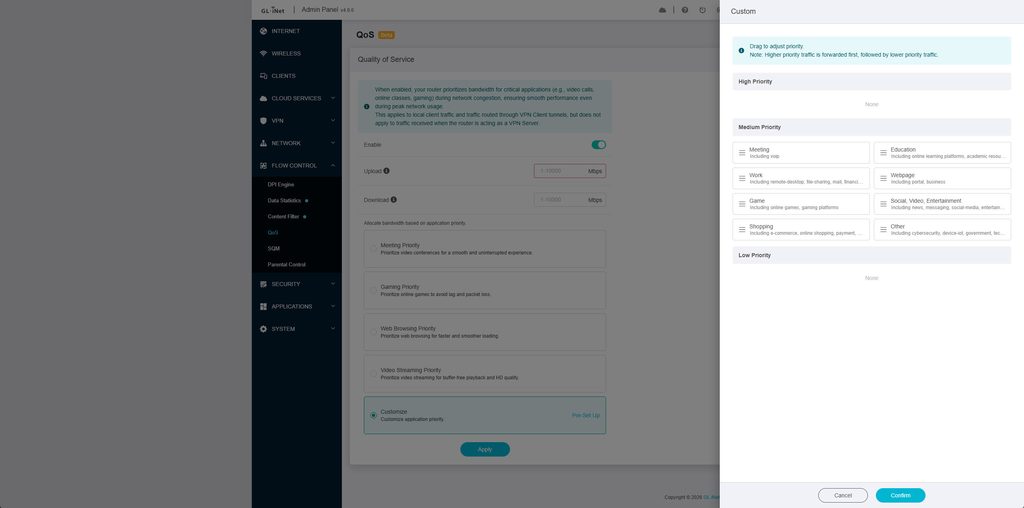
The Customise choice helps you to drag software classes between Excessive, Medium and Low precedence. The classes are Assembly, Training, Work, Webpage, Sport, Social/Video/Leisure, Purchasing and Different. Every thing begins in Medium, so nothing modifications till you progress classes round. QoS applies to native consumer site visitors and VPN consumer tunnels, however to not site visitors arriving when the router is appearing as a VPN server.
I couldn’t see an choice to prioritise particular person units from this web page, which might be helpful for giving a piece laptop computer precedence throughout video calls whatever the software.
SQM
SQM (Sensible Queue Administration) tackles bufferbloat, the latency spikes that happen when your connection is saturated, comparable to throughout a big obtain or cloud backup. It makes use of the cake queue self-discipline, and also you set your add and obtain speeds, ideally barely beneath your measured line velocity.
GL.iNet warns that SQM is resource-intensive and finest suited to lower-bandwidth or congested connections, as it will possibly cut back peak throughput on quicker traces. In apply, it’s most helpful for FTTC broadband, 4G/5G connections or a busy family with a modest connection. On gigabit FTTP, bufferbloat is often much less of a problem. A free bufferbloat check, such because the one from Waveform, will let you know whether or not it’s value enabling. I might choose both QoS or SQM relatively than working each.
Parental Management
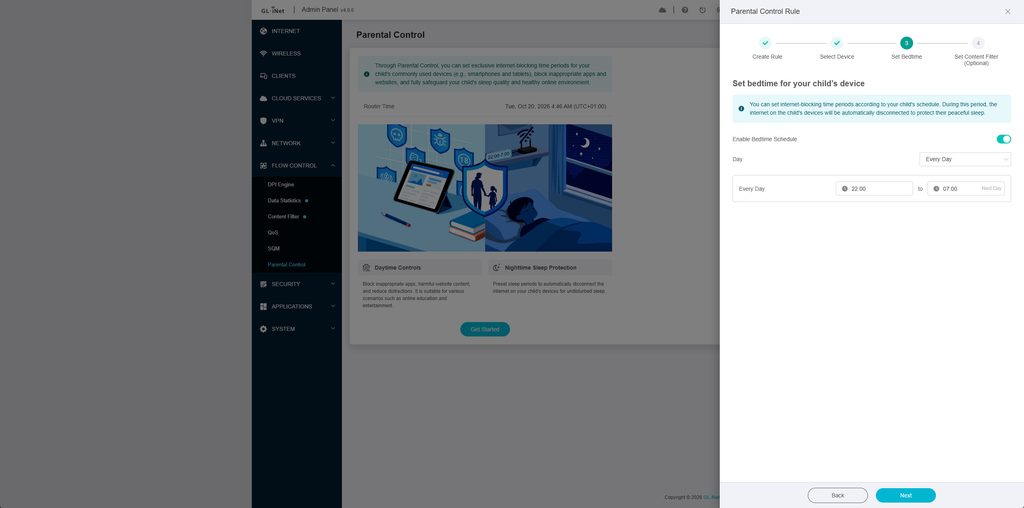
Parental Management is cut up into Daytime Controls, which block apps and web sites, and Nighttime Sleep Safety, which cuts web entry on chosen units at set instances.
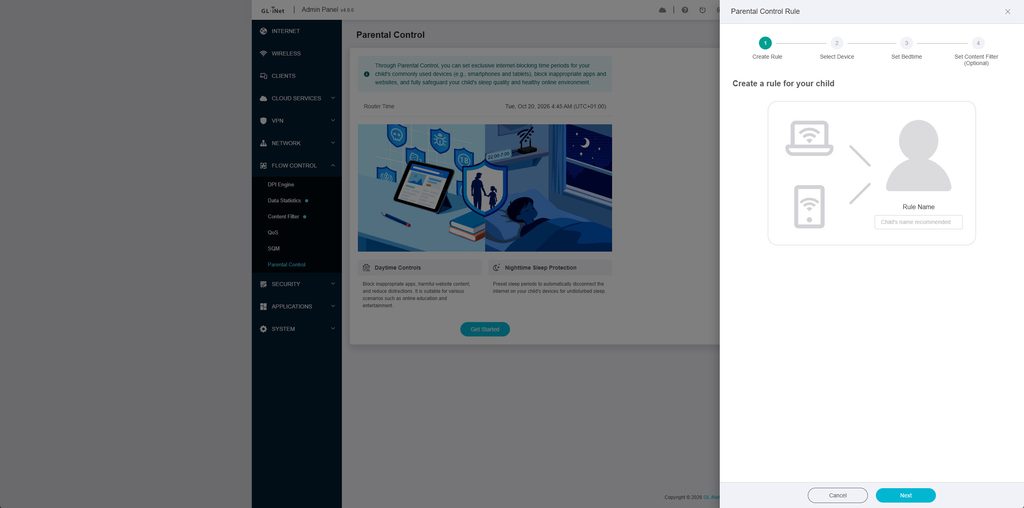
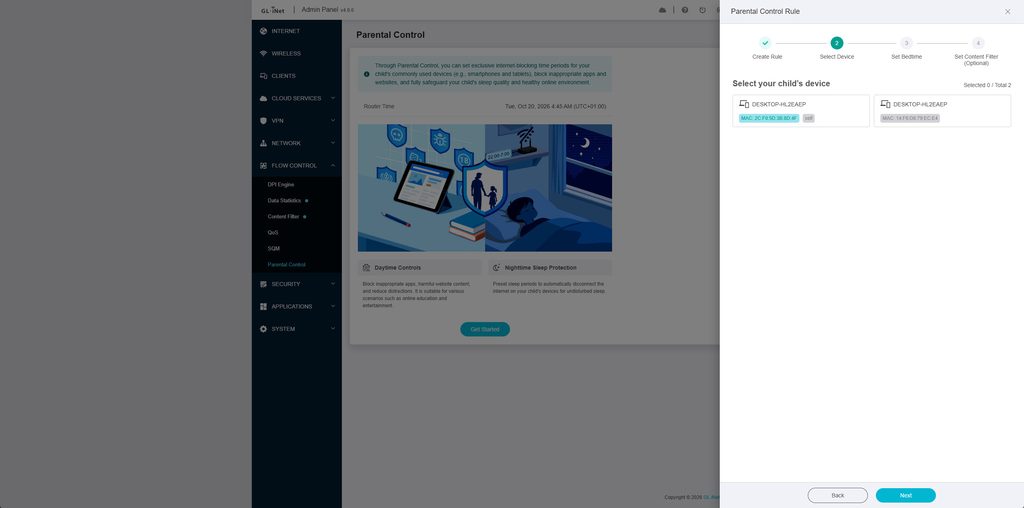
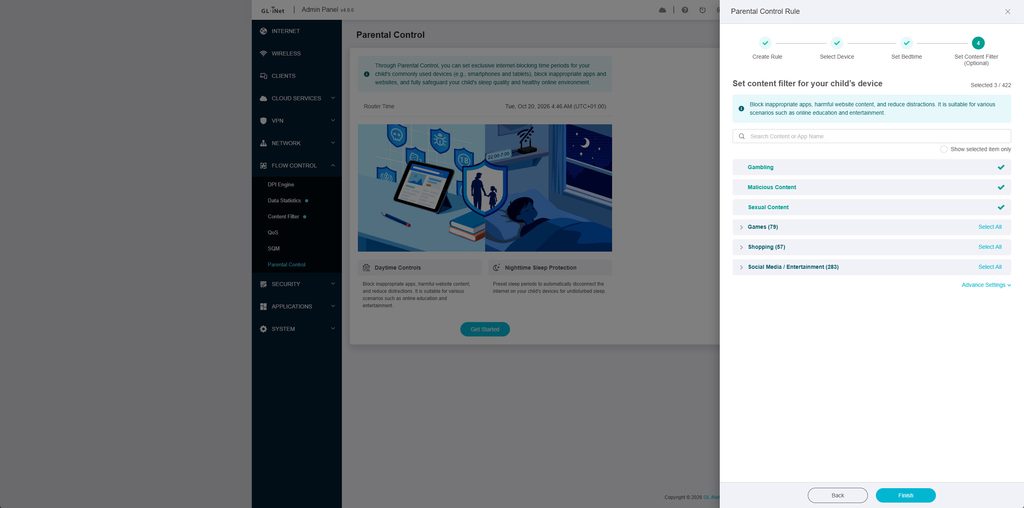
Setting it up makes use of a four-step wizard. You create a rule (GL.iNet suggests utilizing the kid’s identify), choose their units, set a bedtime schedule and optionally apply a content material filter. The default bedtime is 22:00 to 07:00, and you’ll apply it day by day or select particular days. The content material filter covers 422 gadgets, with Playing, Malicious Content material and Sexual Content material chosen by default. You may then block particular person apps or complete classes throughout Video games (79), Purchasing (57) and Social Media/Leisure (283).
That is significantly extra granular than the Aircove, which provided little past blocking grownup websites and setting web entry hours. Having the ability to block TikTok and Roblox whereas leaving YouTube accessible is the kind of management most mother and father need, and it prices nothing additional.
There are some limitations. Units are recognized by MAC handle, and the system picker suffers from the identical naming downside as Knowledge Statistics, with two equivalent hostnames distinguished solely by their MAC addresses. Trendy iPhones and Android telephones use personal, randomised MAC addresses by default. If that handle modifications, comparable to when the kid forgets and rejoins the community, the rule will not apply. You will want to disable the personal handle on your residence community on the kid’s system, which a tech-savvy teenager can simply reverse.
Throughout the wizard, the schedule is a hard and fast blocking window, and there’s no day by day screen-time allowance. As with all router-based controls, nothing stops a toddler from switching to cell information. Lastly, as talked about above, these guidelines cease working if AdGuard House is ready to deal with consumer requests.
LuCI – Superior Settings
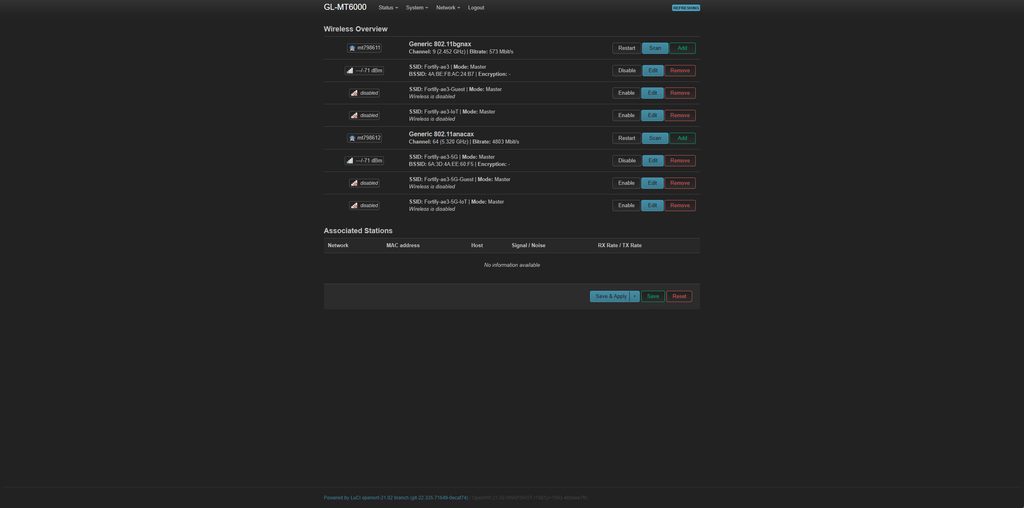
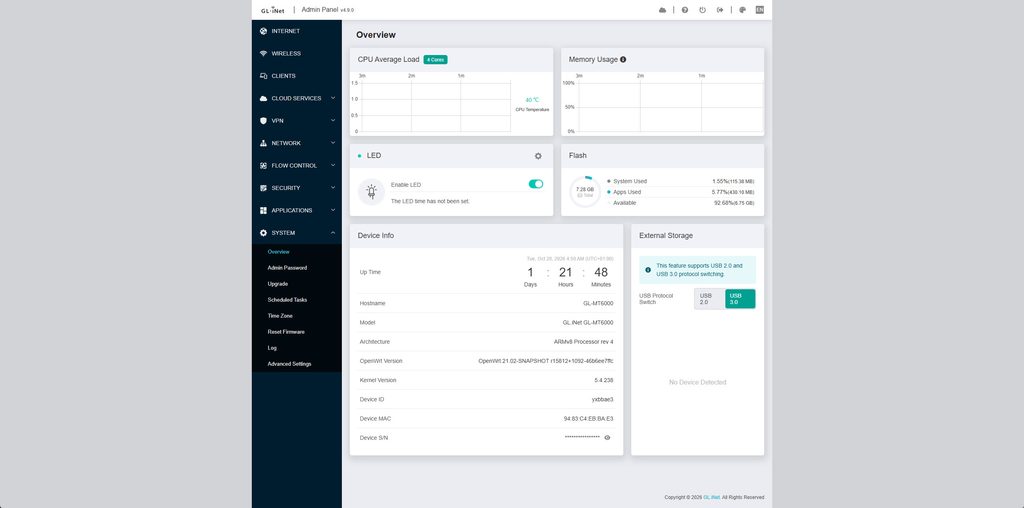
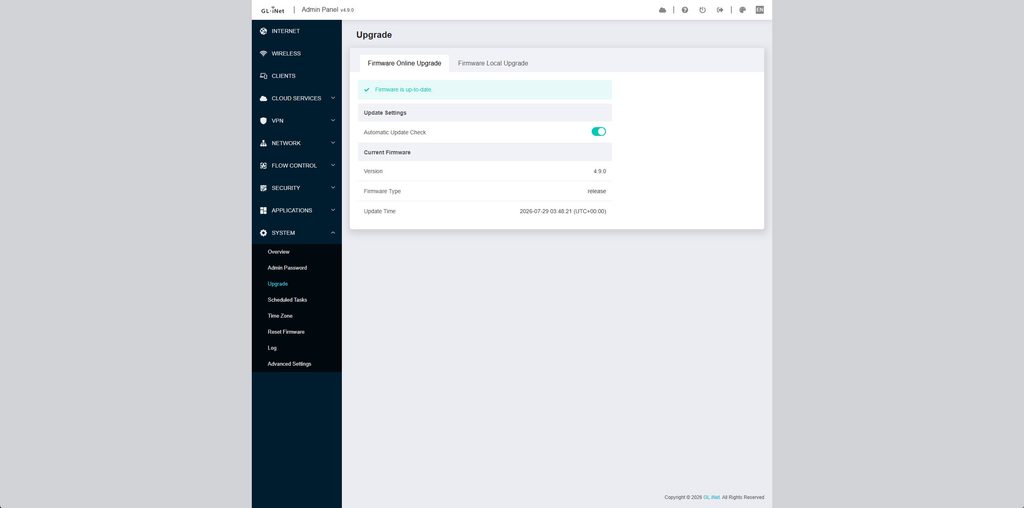
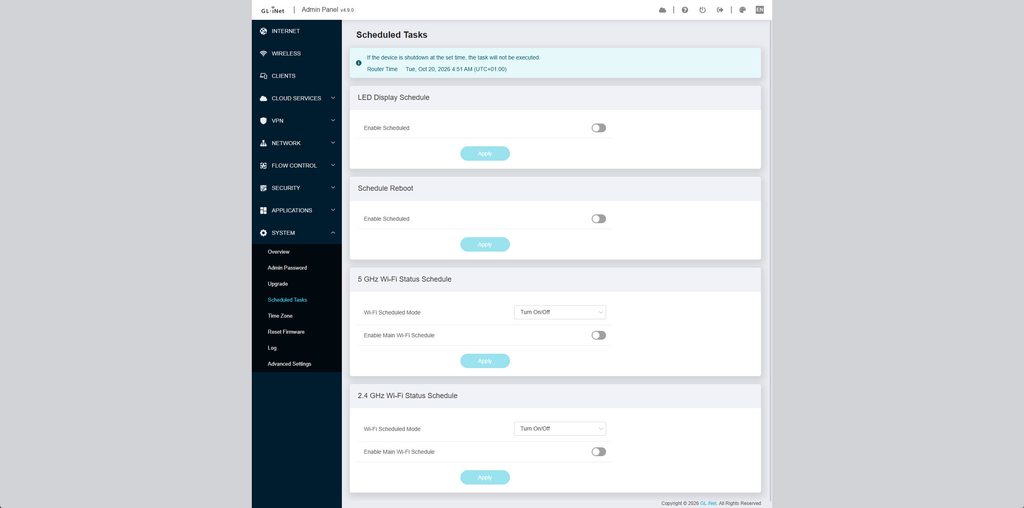
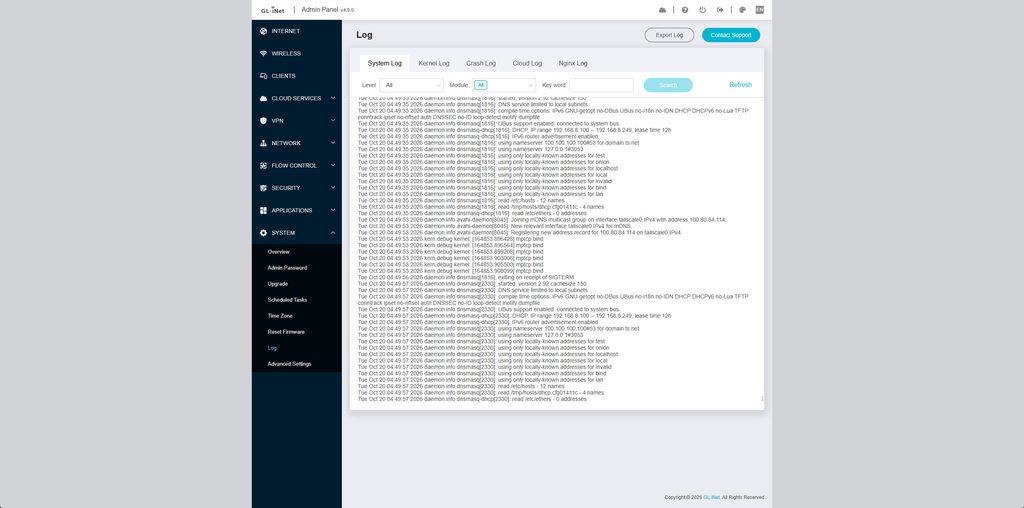
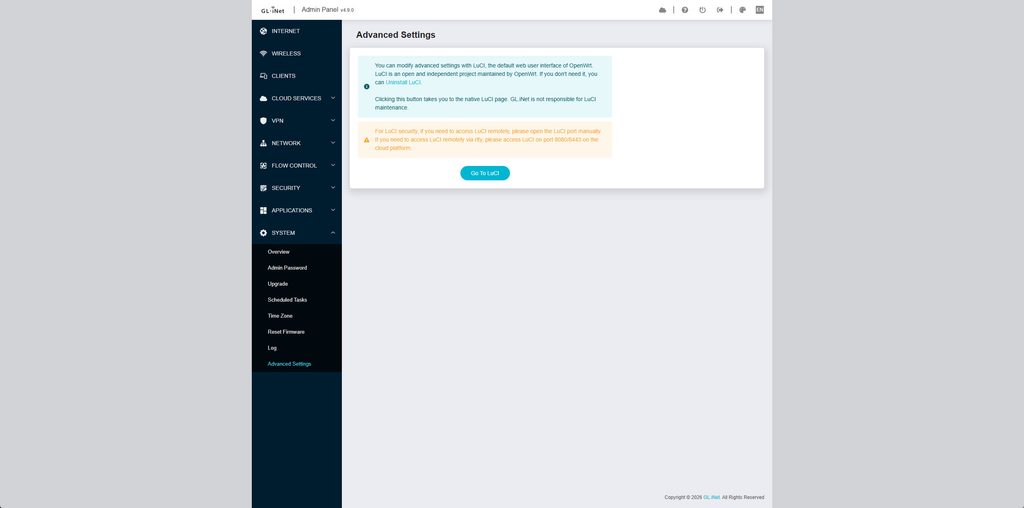
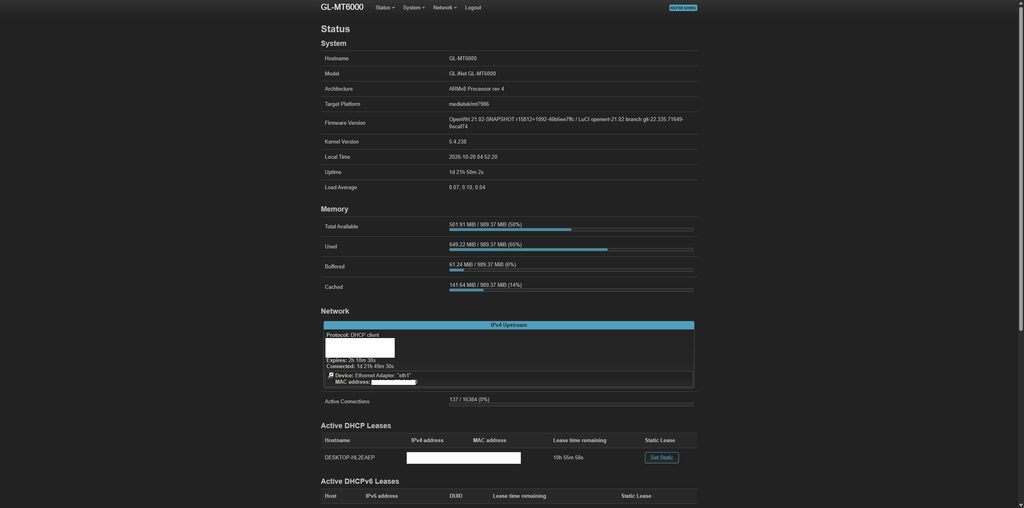
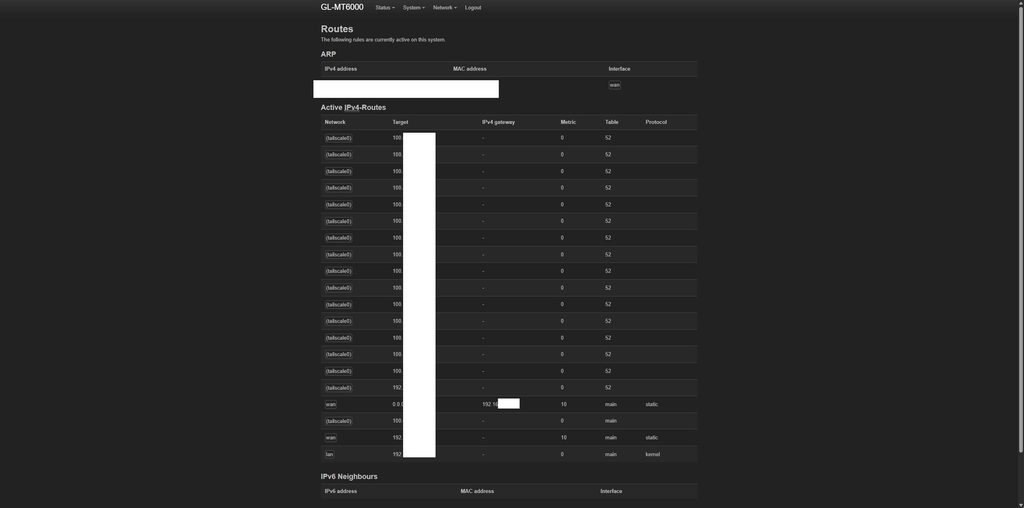
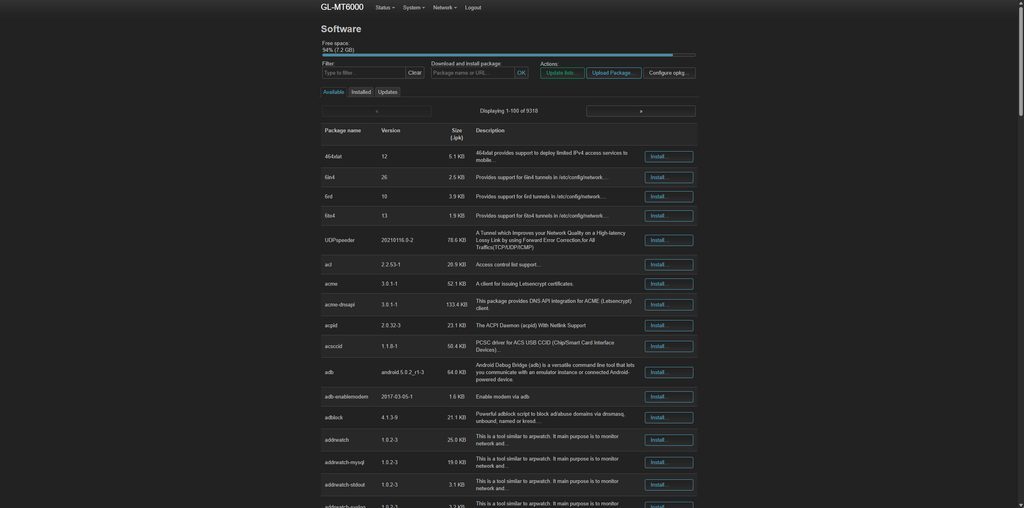
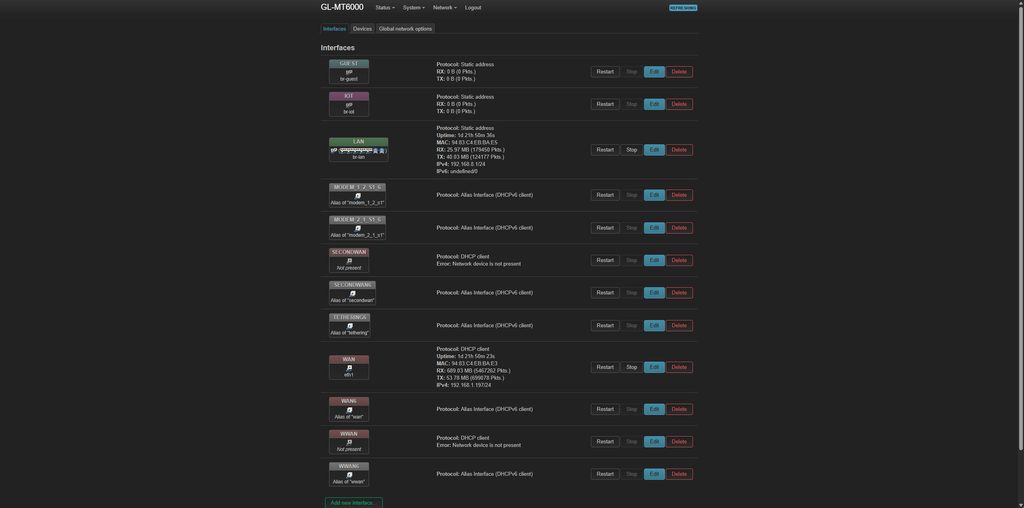
Beneath the GL.iNet interface is OpenWrt, and you’ll entry the usual LuCI internet interface from the Superior Settings choice within the System menu. It makes use of the identical admin password as the principle panel.
LuCI exposes settings that aren’t out there within the GL.iNet interface. This consists of detailed firewall zones and site visitors guidelines, customized VLANs, static routes, scheduled duties, startup scripts, extra detailed wi-fi choices and full package deal administration. You too can allow SSH and handle the router from the command line.
One sensible use is House Assistant. The OpenWrt integration in House Assistant can report which wi-fi purchasers are linked, which you need to use for presence detection. Getting this to work requires putting in the related RPC packages by means of LuCI or SSH, so it isn’t plug and play, however it’s potential, which is greater than you’ll be able to say for many shopper routers.
The same old warning applies. The GL.iNet interface and LuCI each write to the identical configuration information, and modifications made in a single may be overwritten by the opposite, notably after a firmware replace. Should you make modifications in LuCI, preserve a observe of what you modified and take a backup earlier than updating the firmware.
It is usually value mentioning that the GL-MT6000 is nicely supported by the official OpenWrt venture, so you can flash vanilla OpenWrt for those who needed to. This is likely one of the causes the Flint 2 is widespread with fanatics. Doing this is able to take away the GL.iNet interface and the ExpressVPN integration, although, so for many Fortify homeowners, LuCI entry is the higher compromise.
The unique Aircove provided nothing like this. Its interface was easy and polished, however you can not transcend the choices ExpressVPN selected to show. The Fortify works simply as nicely for somebody who solely needs to arrange the ExpressVPN tunnels and depart it alone, nevertheless it doesn’t maintain again anybody who needs extra management.
WiFi Efficiency
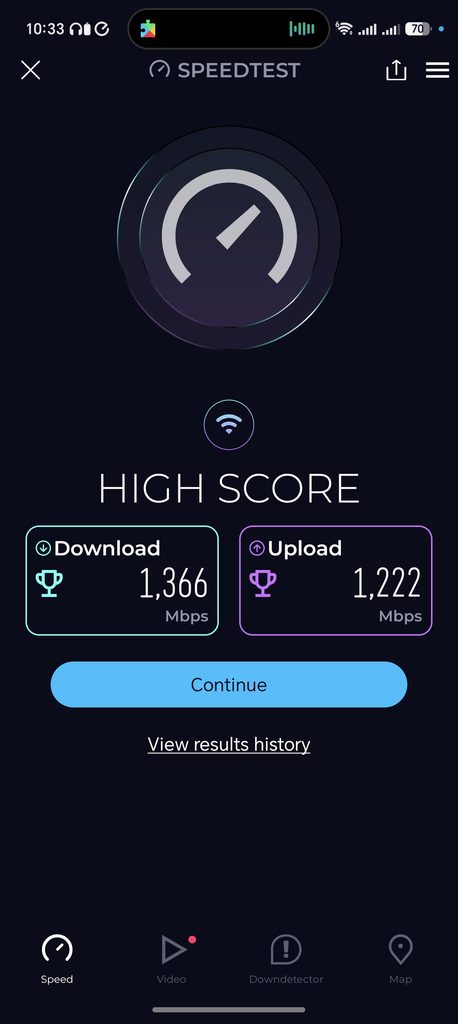
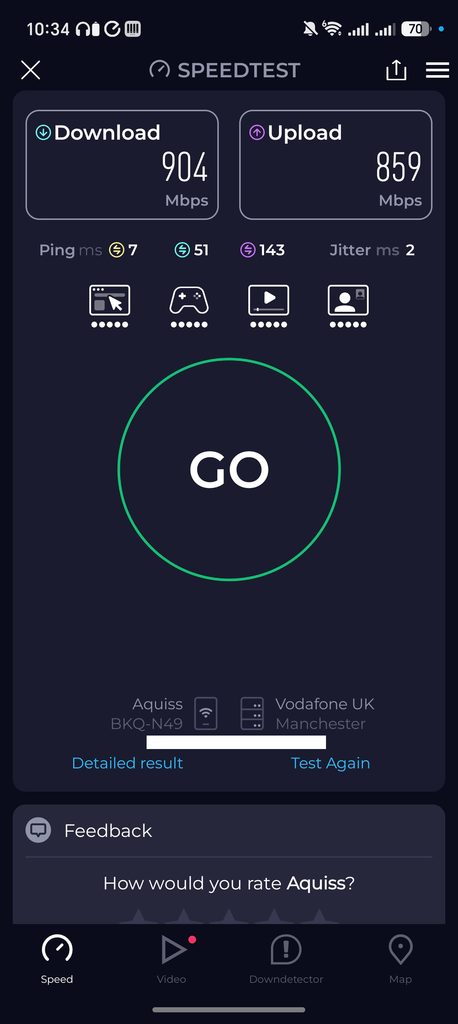
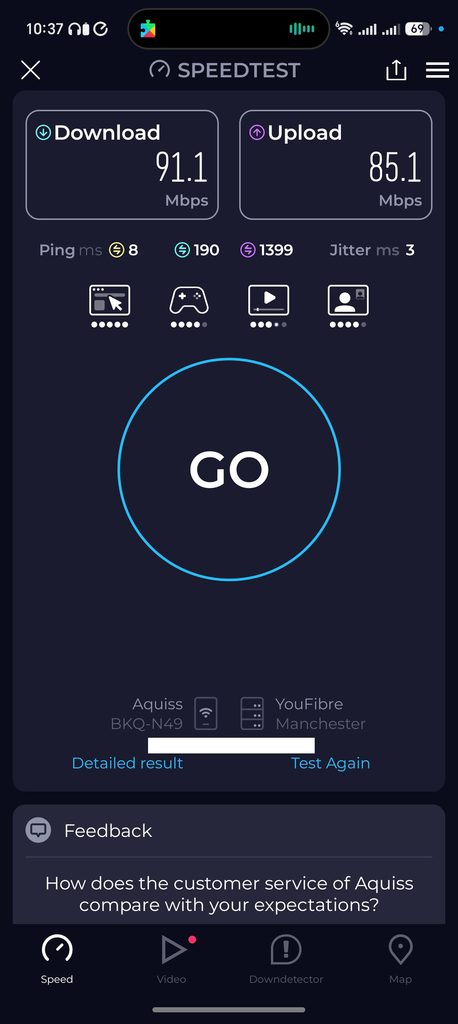
I examined the Wi-Fi utilizing my telephone and the Speedtest app, linked to my Aquiss 2,500 Mbps CityFibre connection. As these are web velocity exams, the outcomes embrace the broadband line and the velocity check server, however my connection is quick sufficient that the Wi-Fi hyperlink is the limiting issue. All three exams had been run from the identical place a brief distance from the router, a couple of minutes aside.
| Band / channel width | Obtain | Add | Idle ping | Loaded latency (down / up) |
|---|---|---|---|---|
| 5 GHz 160 MHz | 1,366 Mbps | 1,222 Mbps | 7 ms | 32 ms / 43 ms |
| 5 GHz 80 MHz | 904 Mbps | 859 Mbps | 7 ms | 51 ms / 143 ms |
| 2.4 GHz | 91.1 Mbps | 85.1 Mbps | 8 ms | 190 ms / 1,399 ms |
With 160 MHz enabled on 5 GHz, I achieved 1,366 Mbps obtain and 1,222 Mbps add. That’s quicker than a gigabit Ethernet connection, which is barely potential as a result of the Fortify has a 2.5GbE WAN port. A router with a gigabit WAN would have capped this at round 940 Mbps whatever the Wi-Fi velocity.
Dropping to 80 MHz gave me 904 Mbps obtain and 859 Mbps add, with an idle ping of seven ms and jitter of two ms. That is roughly what I might anticipate from a 2×2 Wi-Fi 6 consumer on an 80 MHz channel, which has a theoretical hyperlink price of 1,201 Mbps.
For comparability, the Flint 3 achieved over 1.8 Gbps on 6 GHz with a supported laptop computer, so Wi-Fi 7 nonetheless has a transparent benefit at shut vary if in case you have the consumer units to make use of it. Then again, the unique Aircove solely managed 590 Mbps in the identical room, because it was restricted to 80 MHz channels and a couple of×2 MIMO. The Fortify is an enormous step up from what ExpressVPN beforehand provided.
There are some caveats with 160 MHz on 5 GHz within the UK. A 160 MHz channel takes up a big share of the out there spectrum and consists of DFS channels, which need to be vacated if radar is detected. The Fortify selected channel 64 by default, which is a DFS channel, so the 5 GHz community can take round a minute to seem after a reboot whereas the router checks for radar. Should you dwell in a flat or a terraced home with numerous neighbouring networks, 80 MHz could also be extra dependable. In a indifferent home, or for those who solely have one entry level, 160 MHz is value attempting.
The two.4 GHz results of 91.1 Mbps obtain and 85.1 Mbps add is modest. The 1,148 Mbps score assumes a 4×4 consumer on a 40 MHz channel with 1024-QAM, which no telephone helps, and a couple of.4 GHz is congested in most UK properties. The loaded latency is the extra telling determine, with add latency reaching nearly 1.4 seconds when the connection was saturated. I might use 2.4 GHz for IoT units and vary relatively than velocity, which is how most individuals use it anyway.
The 4×4 MIMO design and eight high-power front-end modules ought to assist with vary. GL.iNet quotes protection of as much as round 140 sq. metres in an open surroundings, which is an inexpensive estimate for a typical UK three-bedroom home with the router positioned centrally. Brick partitions and a number of flooring will cut back this.
As with the Flint 3, there is no such thing as a user-friendly mesh choice like TP-Hyperlink EasyMesh or Asus AiMesh. When you have a bigger residence, you have to so as to add separate entry factors or use GL.iNet’s extender mode, which is much less polished. That is the principle space the place the large shopper manufacturers have a bonus.
Value and Different Choices
The ExpressVPN Fortify is obtainable now for £180.99/$200 and consists of one 12 months of ExpressVPN for brand new or returning prospects. The GL.iNet Flint 2 (GL-MT6000) is obtainable for £153. So, you’re paying a £28 premium for the Fortify, however you get a 12 months of VPN totally free, which is value £75 based mostly on the completely discounted pricing on the ExpressVPN web site.
The extra highly effective Flint 3 (GL-BE9300) is obtainable for £180, however you’d want to purchase a VPN subscription on prime of this.
It’s value fascinated by what occurs after the primary 12 months. To say the plan, that you must enter a fee methodology, and the subscription will auto-renew except you cancel it. If you don’t intend to maintain ExpressVPN, cancelling early is easy and doesn’t have an effect on the free 12 months. Should you do preserve it, the renewal shall be at ExpressVPN’s commonplace pricing, so it’s value buying round for a reduced plan at that time.
In comparison with the earlier ExpressVPN routers, the pricing is rather more affordable. The Aircove was £294 RRP within the UK after I reviewed it, and round £230 discounted, for a lot weaker {hardware} and no included subscription. I criticised it for being wildly overpriced within the UK, and that isn’t the case with the Fortify.
If you don’t want ExpressVPN, the Flint 2 is the apparent various, as it’s the identical router for much less cash and comes with the pre-configured profiles for over 30 VPN suppliers. If you’d like Wi-Fi 7 and extra 2.5GbE ports, the Flint 3 is value the additional value. Asus additionally provides policy-based VPN routing on lots of its routers by means of VPN Fusion, and it has AiMesh, however the VPN options are much less versatile than GL.iNet’s, and there’s no built-in AdGuard House or Tailscale.
General
I just like the ExpressVPN Fortify. I believe it’s significantly better than the earlier ExpressVPN choices, because it retains mainly all of the performance from the Flint 2, apart from VPN profiles for various suppliers not being arrange for you.
As a shopper router, the Fortify/Flint 2 has an impressive vary of options that outclass most family names comparable to TP-Hyperlink and Netgear.
The inclusion of policy-based VPN routing, AdGuard, and Tailscale elevates this router far above the performance you’ll get from many different manufacturers.
If I had been parting with my very own cash, I’d be inclined to stay with a GL.iNet branded router, then use no matter VPN supplier I needed, even when the full value was slightly extra. However the ExpressVPN Fortify does work out cheaper than the Flint 2 when factoring in the price of the VPN, and ExpressVPN is likely one of the higher VPN choices on the market.
General, the ExpressVPN Fortify is a superb shopper router that fixes nearly each criticism I had with the Aircove. It’s not locked to ExpressVPN, it has much more succesful {hardware}, and it retains the complete GL.iNet function set, together with AdGuard House, Tailscale, multi-WAN and LuCI entry.
It’s not with out flaws. System identification within the consumer checklist and parental controls wants work, solely two of the Ethernet ports are 2.5GbE, there is no such thing as a correct mesh help, and the sheer variety of options means some settings battle with one another, comparable to AdGuard House and domain-based VPN guidelines. The two.4 GHz efficiency can be unremarkable.
Nevertheless, for anybody who needs to run a VPN at router stage, notably with domain-based guidelines to keep away from On-line Security Act ID checks, this is likely one of the finest choices out there, and the included 12 months of ExpressVPN makes it good worth.
ExpressVPN Fortify Router Evaluate
90%
Abstract
The ExpressVPN Fortify is a GL.iNet Flint 2 with ExpressVPN integration and a 12-month ExpressVPN Superior plan included. Not like the Aircove, it isn’t locked to ExpressVPN, and it retains the complete GL.iNet function set. Wi-Fi efficiency is powerful on 5 GHz, the VPN {hardware} is way extra succesful than the Aircove, and as soon as the VPN subscription is factored in, it’s cheaper than shopping for a Flint 2 and a VPN individually.
Professionals
- Contains 12 months of ExpressVPN
- Not locked to ExpressVPN, so you’ll be able to import WireGuard or OpenVPN profiles from different suppliers
- Versatile policy-based routing by system, community, area or IP
- AdGuard House, Tailscale, ZeroTier and DPI-based instruments at no additional value
- Over 1.3 Gbps on 5 GHz 160 MHz with a 2.5GbE WAN
- Multi-WAN failover and cargo balancing
- Full LuCI entry and eight GB of storage for packages
Cons
- Solely two 2.5GbE ports
- No user-friendly mesh help
- Consumer checklist and parental controls battle with duplicate hostnames and randomised MAC addresses
- AdGuard House consumer dealing with conflicts with domain-based VPN guidelines
- Modest 2.4 GHz efficiency
- A GL.iNet Flint 2 is cheaper if you have already got a VPN subscription

I’m James, a UK-based tech fanatic and the Editor and Proprietor of Mighty Gadget, which I’ve proudly run since 2007. Obsessed with all issues expertise, my experience spans from computer systems and networking to cell, wearables, and sensible residence units.
As a health fanatic who loves working and biking, I even have a eager curiosity in fitness-related expertise, and I take each alternative to cowl this area of interest on my weblog. My numerous pursuits permit me to deliver a novel perspective to tech running a blog, merging life-style, health, and the most recent tech developments.
In my educational pursuits, I earned a BSc in Data Programs Design from UCLAN, earlier than advancing my studying with a Grasp’s Diploma in Computing.
I’m proud to share that Vuelio has persistently ranked Mighty Gadget as one of many prime expertise blogs within the UK. With my dedication to expertise and drive to share my insights, I goal to proceed offering my readers with partaking and informative content material.
I work immediately with the businesses he evaluations merchandise for or their chosen PR company.
For Social Media, you’ll find me on:

