



It has been a bit over a yr since I reviewed an EnGenius networking product, with my final evaluation being the EnGenius ECW520.
EnGenius has now despatched me their new ECW515 in-wall entry level, which, because the title suggests, mounts on the wall, with the uplink port connecting to the again of the AP.
Aside from the choice mounting location, the principle good thing about this entry level is the inclusion of extra Ethernet ports, permitting it to work as a small change to increase the community. This additionally features a PoE out port, so you may energy an extra gadget.
It’s a dual-band entry level, so in contrast to the ECW520 there isn’t a 6 GHz radio. It qualifies as Wi-Fi 7 as a result of it helps 802.11be options equivalent to 4096-QAM, Multi-Hyperlink Operation (MLO) and multi-RU on the two.4 GHz and 5 GHz bands, quite than due to any further spectrum. That makes it a really completely different proposition from the tri-band ceiling APs I usually check, and it’s best judged as a utility gadget that provides Wi-Fi and wired ports to a room from a single cable run.
Specification
| Specification | ECW515 |
|---|---|
| Sort | Cloud-managed indoor wi-fi entry level |
| Wi-Fi customary | Wi-Fi 7 (IEEE 802.11be), backwards appropriate with 802.11b/g/n/ac/ax |
| Wi-fi bands | Twin-band 2.4 GHz and 5 GHz; simultaneous operation |
| Most wi-fi knowledge charges | 2.4 GHz: 700 Mbps; 5 GHz: 2,900 Mbps; mixed: 3,600 Mbps |
| Spatial streams | 2×2 MIMO, two spatial streams per band |
| Most channel width | 2.4 GHz: 40 MHz; 5 GHz: 160 MHz |
| Wi-fi applied sciences | SU-MIMO, MU-MIMO, OFDMA, transmit beamforming and 4096-QAM |
| Processor | Qualcomm Networking Professional 1220 |
| Antennas | 2 x 5 dBi antennas per band |
| Most transmit energy | 2.4 GHz: 21 dBm; 5 GHz: 22 dBm, topic to regional limits |
| Ethernet ports | 1 x 2.5GbE RJ45 with PoE enter; 4 x Gigabit Ethernet RJ45 |
| PoE output | 802.3af on LAN5; 7 W when powered by PoE+, as much as 15 W when powered by DC |
| Working modes | Entry level, Mesh and Mesh AP |
| Most concurrent shoppers | As much as 100 |
| SSIDs | 8 SSIDs for two.4 GHz and 5 GHz |
| VLAN assist | 802.1Q SSID-to-VLAN tagging, cross-band VLAN pass-through and administration VLAN |
| Wi-fi safety | WPA3 Enterprise, WPA3-Private (SAE), WPA2 Enterprise, WPA2-Private and WPA2/WPA3 combined mode |
| Community isolation | Shopper isolation, Layer 2 isolation and MAC deal with filtering |
| Administration protocols | SNMP v1, v2c and v3 |
| High quality of service | IEEE 802.11e / WMM |
| Energy enter | IEEE 802.3at PoE+ or 54 V DC, 1 An influence adaptor |
| Most energy consumption | 18 W through PoE; 26 W through DC |
| Energy equipment | DC energy adaptor and PoE+ injector not included |
| Working temperature | 0°C to 40°C |
| Working humidity | As much as 90%, non-condensing |
| Dimensions | 130 x 110 x 42 mm |
| Weight | 328 g |
| Included equipment | Ceiling/wall mounting screw kits, tall/brief junction plates and fast set up information |
| Guarantee | 5 years |
Design
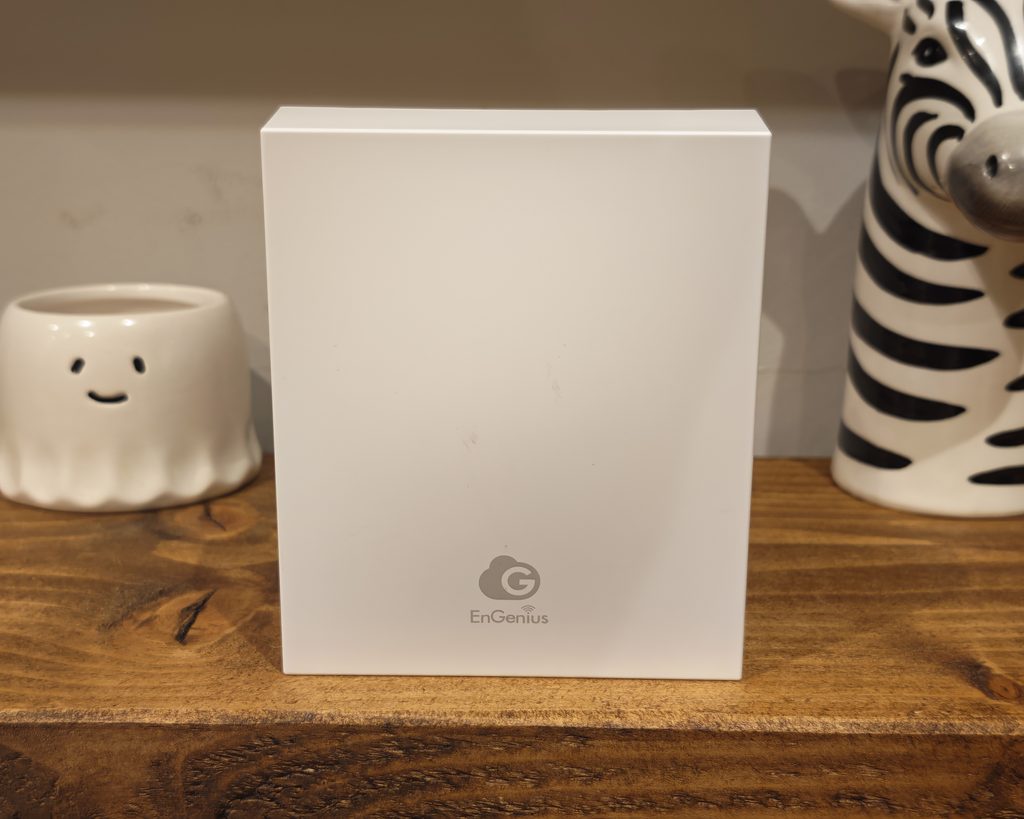
That is in contrast to the opposite EnGenius entry factors I’ve reviewed, that are all conventional ceiling-mounted APs.
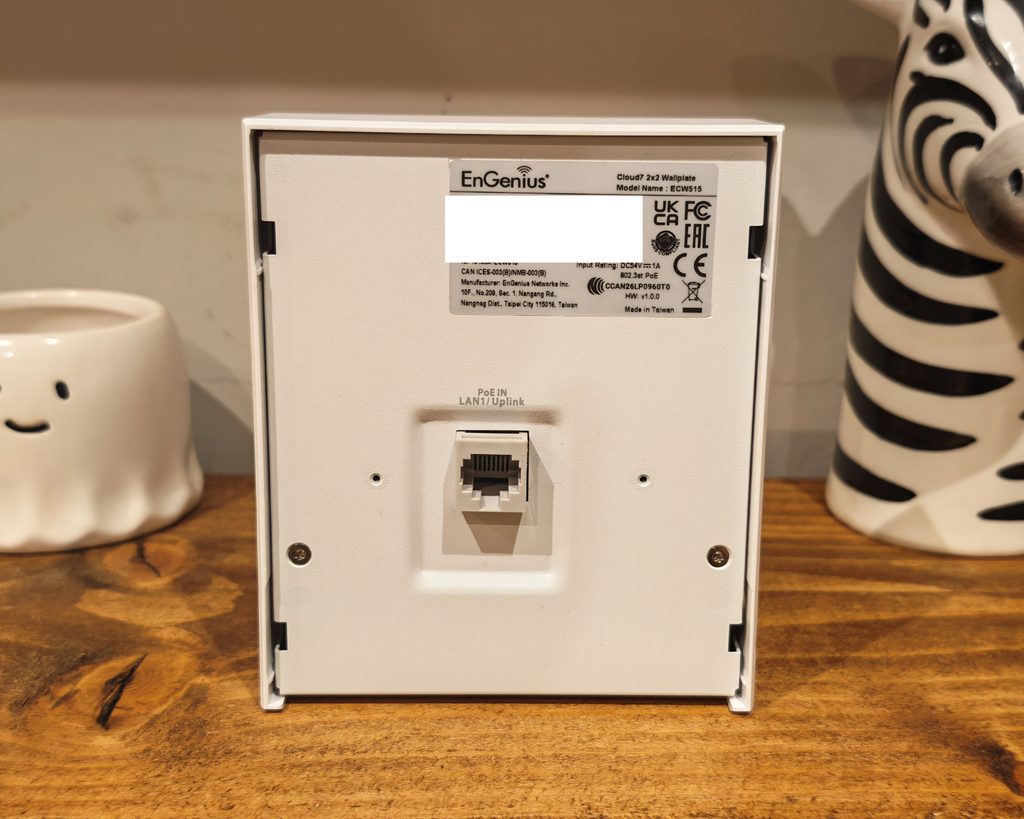
With this, it’s wall-mounted, with the uplink port at the back of the AP and Ethernet out of the wall into the again of the AP.
The opposite massive distinction right here is that this contains 4 extra Ethernet ports on the underside, together with a 2nd uplink port, one gigabit PoE out port and two extra gigabit ports.
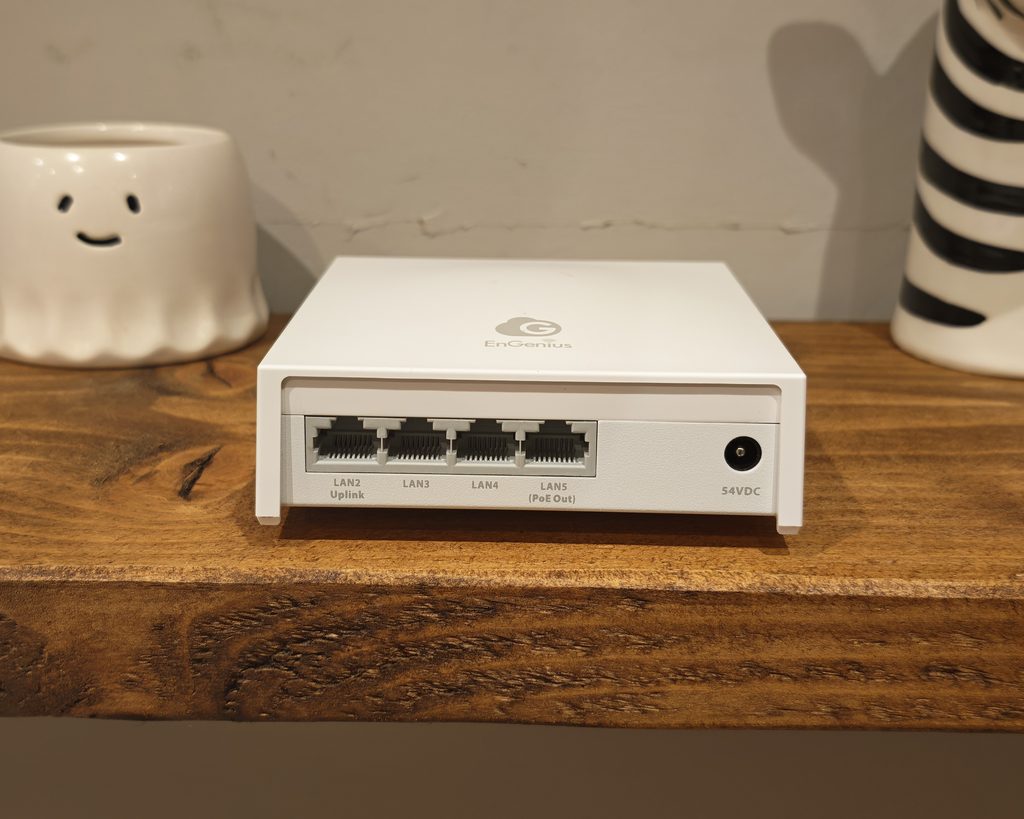
It’s a bit disappointing that the principle uplink port is 2.5GbE, however not one of the extra ports is 2.5GbE.
Like most EnGenius APs, this additionally advantages from a DC port enter, providing you with some flexibility on find out how to energy it, however no energy adaptor is included.
This makes it interesting for residence customers or small companies the place it’s possible you’ll not have run a number of Ethernet cable for a number of ports per room. In a industrial setting, I might say this can probably be greatest suited as a utility AP to increase the community to less-used elements of an workplace/constructing.
Bodily, it’s a plain white field with a small EnGenius Cloud emblem on the entrance. The entrance cowl is plastic, whereas the rear is a metallic plate that additionally acts because the heatsink. The PoE IN LAN1/Uplink port sits in a recessed nicely in the course of the rear panel, so a cable popping out of a wall field or keystone jack plugs straight in behind the unit. The underside edge has the 4 Gigabit ports, labelled LAN2 Uplink, LAN3, LAN4 and LAN5 (PoE Out), alongside the 54 V DC barrel enter. The reset pinhole is on the aspect, and the label on the again marks it as indoor solely.
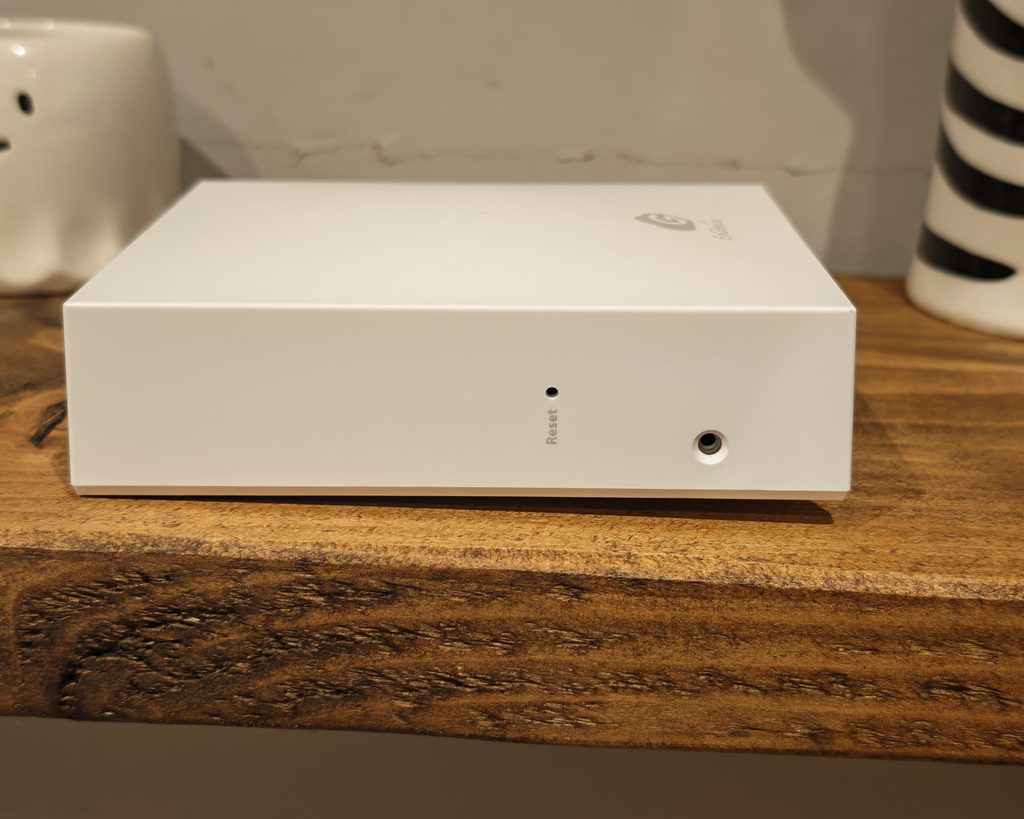
At 130 x 110 x 42 mm, it’s compact for a tool with 5 Ethernet ports, nevertheless it sits additional off the wall than a flush wall plate and is a bit of bigger than the UniFi U7 In-Wall. It’s fanless, so it’s silent in use. The metallic rear will get heat to the contact after a couple of hours, which is anticipated as it’s doing the job of a heatsink, however I didn’t see any instability or drop in efficiency that I might attribute to warmth. If you’re pondering of 3D printing your individual mount quite than utilizing the equipped plate, PETG could be a safer alternative than PLA.
Set Up
If you’re conversant in EnGenius merchandise, then the set-up is a breeze. You’ll be able to both scan the QR code on the again of the AP utilizing the EnGenius Cloud app or manually add the serial quantity to the web-based interface. You then simply have to assign it to the community, and it’ll decide up any present WiFi settings.
In my case, the AP up to date itself to firmware 1.9.106 shortly after adoption and began broadcasting the SSIDs I already had configured for my EnGenius check community, with the nation set to the UK within the radio settings. The entire course of took a couple of minutes, most of which was ready for the firmware replace.
The principle factor to plan for is energy. There isn’t a PoE injector or DC adaptor within the field, and the AP wants 802.3at PoE+ quite than customary 802.3af PoE, so an older PoE change or an inexpensive injector will not be sufficient. EnGenius quotes 18 W most consumption over PoE, excluding something you energy from the PoE out port. I powered mine from a PoE+ change, which is how most individuals will deploy it.
Additionally it is price being clear that this can be a cloud-managed entry level, so that you want an EnGenius account. There’s a native net web page, however it’s restricted to standing info and firmware updates. You can not configure SSIDs or ports from it, so there isn’t a true standalone mode.
EnGenius Cloud Settings
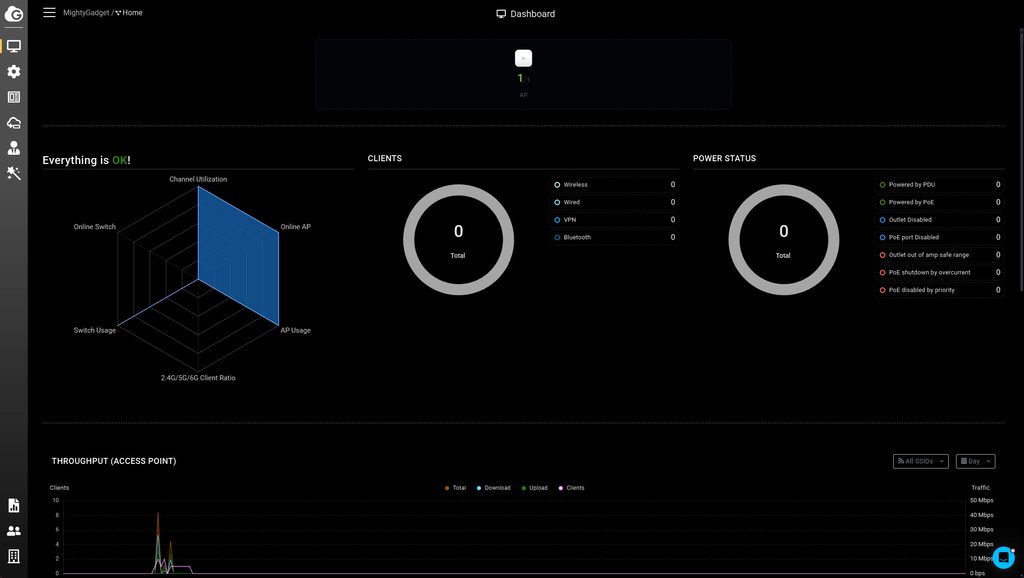
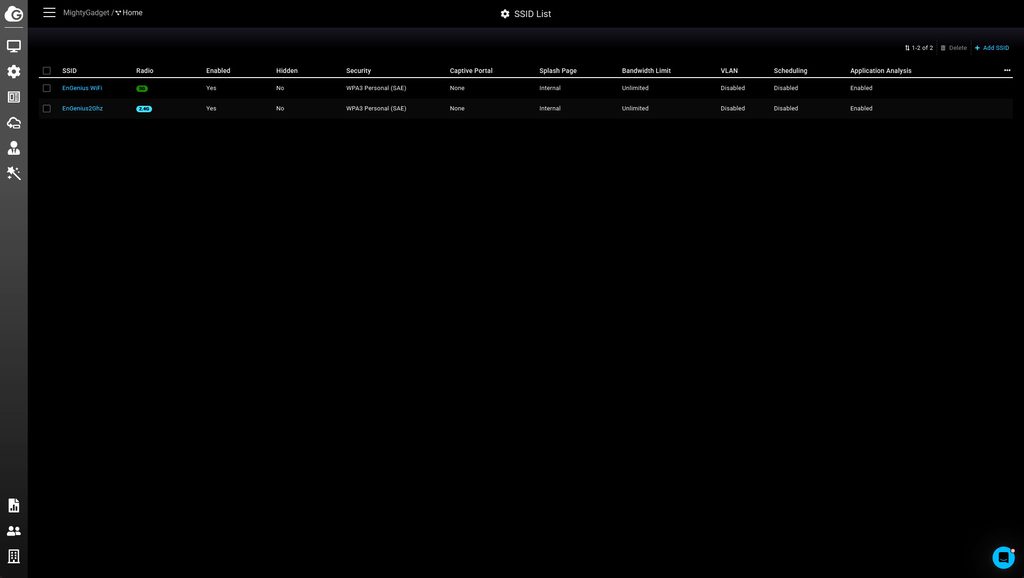
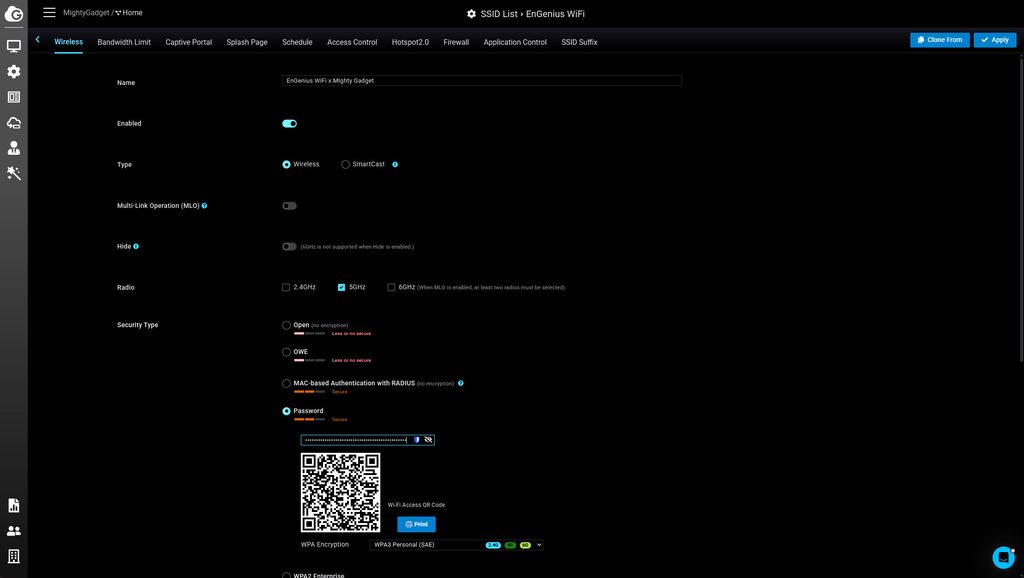
The ECW515 makes use of the identical EnGenius Cloud interface as the remainder of the vary, so if in case you have used the ECW520 or some other EnGenius cloud product, nothing right here can be unfamiliar. You’ll be able to create a number of organisations, every with a number of networks, and settings outlined at community stage are inherited by each AP added to it.
The dashboard provides a fast overview of the well being of the community, with a radar chart protecting channel utilisation, AP and change utilization and the two.4/5/6 GHz consumer ratio, together with consumer counts and throughput graphs. There may be additionally an influence standing panel, which is extra helpful if in case you have EnGenius PoE switches or PDUs reporting into the identical community.
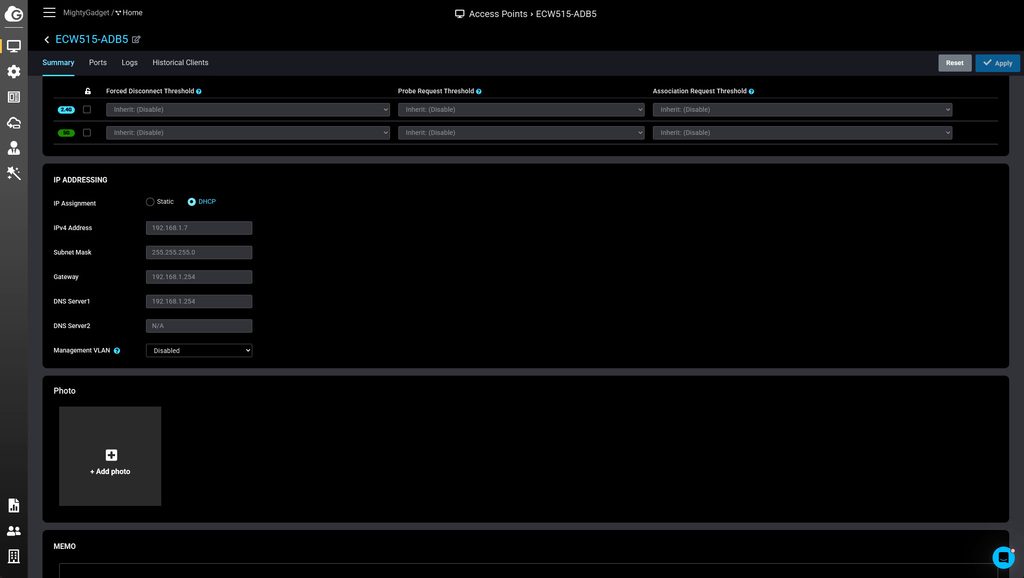
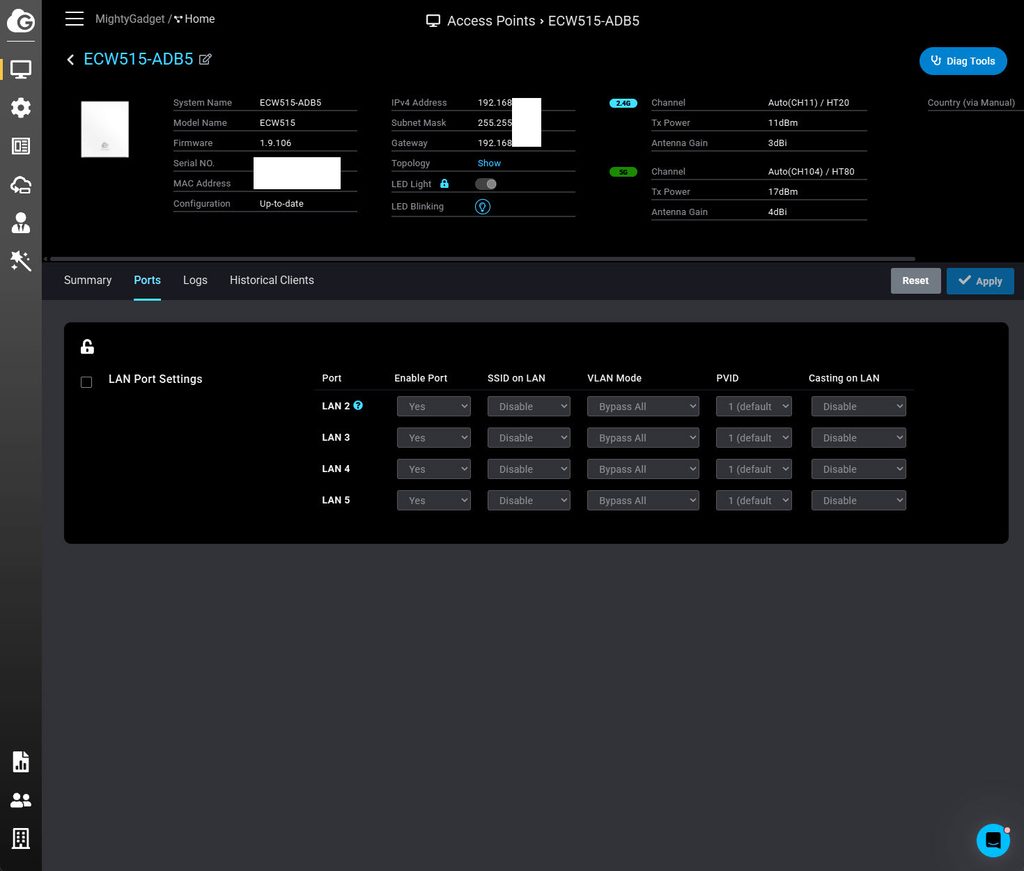
Opening the AP itself exhibits the system particulars, IP deal with, present channels, transmit energy and antenna acquire, with tabs for Abstract, Ports, Logs and Historic Purchasers. The Abstract tab enables you to override the network-wide radio settings for this particular AP, together with channel, goal transmit energy, minimal bitrate, consumer restrict and channel width, in addition to the IP addressing and administration VLAN.
The Ports tab is the place the ECW515 differs from a traditional AP. Every of the 4 Gigabit ports may be enabled or disabled, assigned a VLAN mode and PVID, and arrange with “SSID on LAN”. This binds a selected SSID’s settings to a wired port, so a tool plugged into the wall plate will get the identical VLAN, safety coverage and captive portal as a wi-fi consumer on that SSID. For a lodge room, a gathering room or a house workplace with a visitor community, that may be a sensible characteristic, and it means the wired ports wouldn’t have to be a again door into your major community. There may be additionally a “Casting on LAN” possibility for wired casting units.
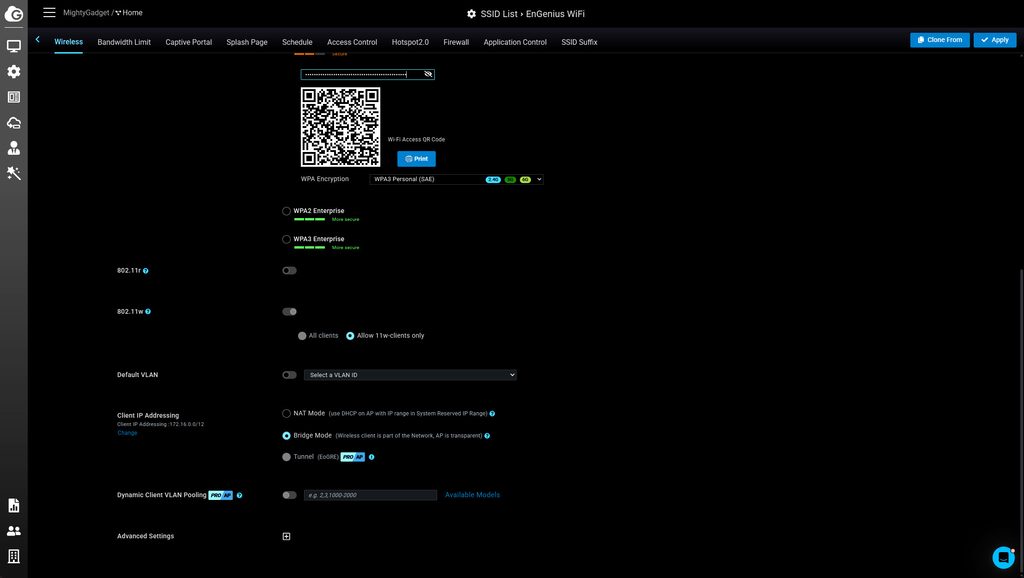
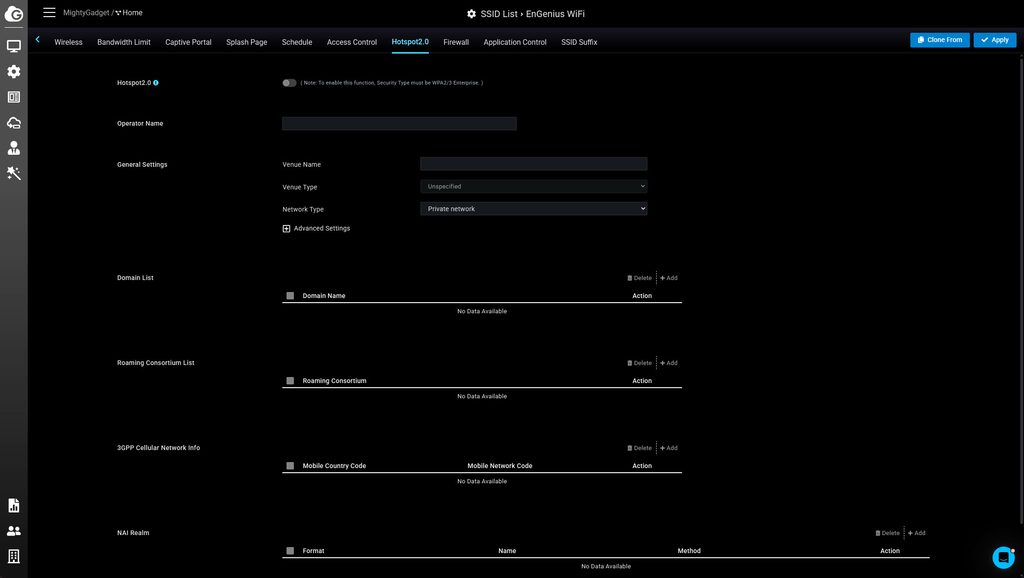
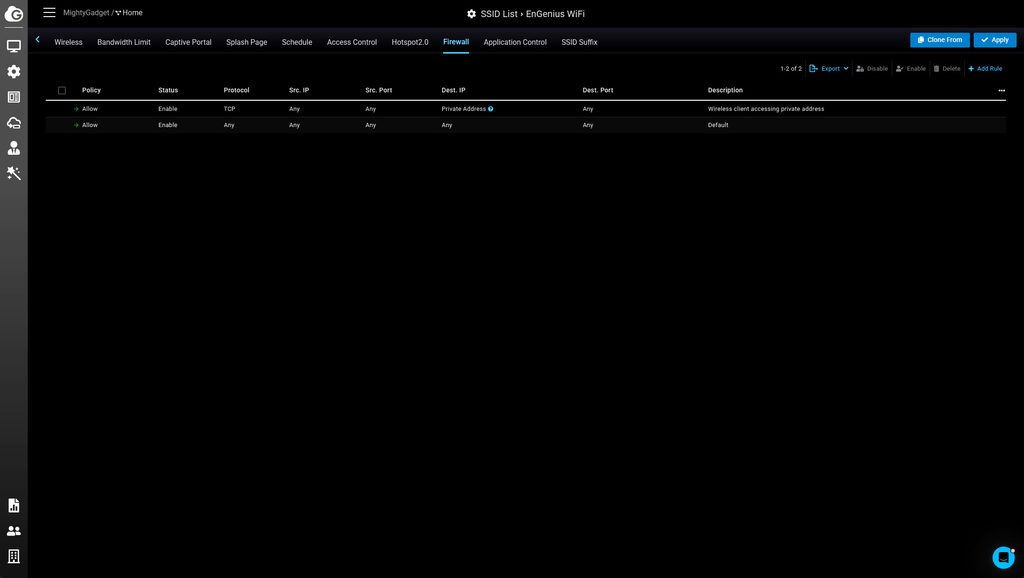
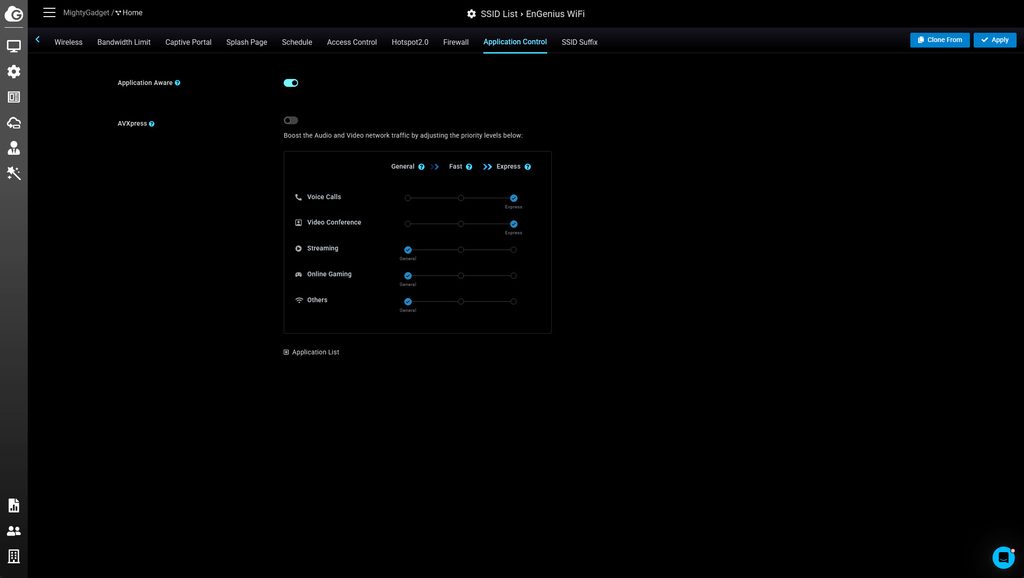
The SSID settings are complete for an AP at this stage. For every SSID, you may select the radios, allow MLO, disguise the community and decide from open, OWE, MAC-based RADIUS, WPA3 Private (SAE), and WPA2 or WPA3 Enterprise safety. There are toggles for 802.11r quick roaming and 802.11w protected administration frames, a default VLAN, and a alternative of NAT mode, bridge mode or a tunnel (EoGRE) for consumer addressing. Alongside the highest, you additionally get tabs for bandwidth limits, captive portal, splash web page, schedules, entry management, Hotspot 2.0, firewall guidelines, utility management and SSID suffixes.
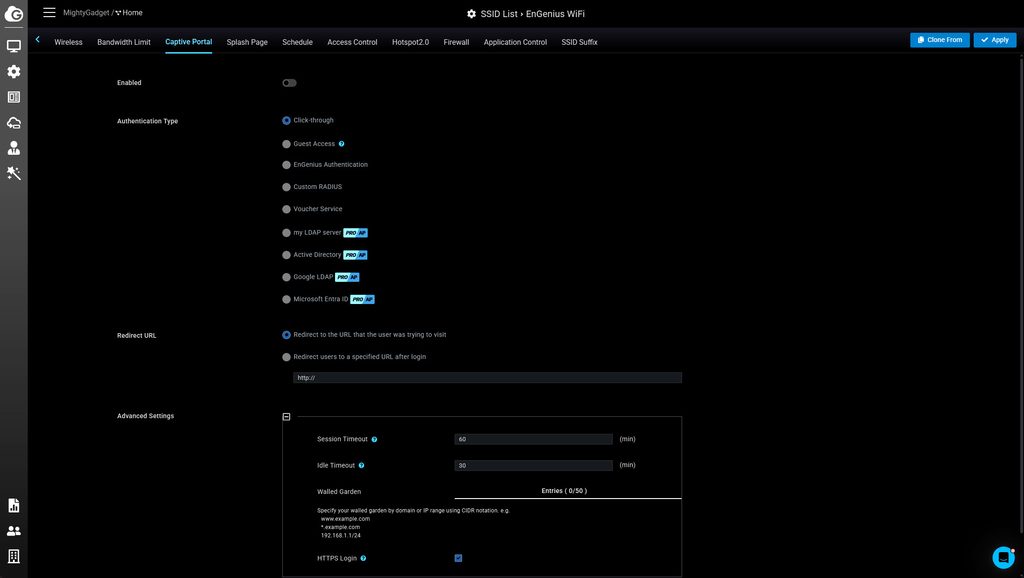
The captive portal helps click-through, visitor entry, EnGenius authentication, customized RADIUS and a voucher service on the free tier. LDAP, Lively Listing, Google LDAP and Microsoft Entra ID authentication are marked as Professional options. Hotspot 2.0 is offered however requires WPA2 or WPA3 Enterprise. Software management contains AVXpress, which helps you to prioritise voice calls, video conferencing, streaming and on-line gaming at Basic, Quick or Categorical ranges. That could be a smart inclusion for a tool aimed toward assembly rooms, although utility evaluation does carry a small efficiency price.
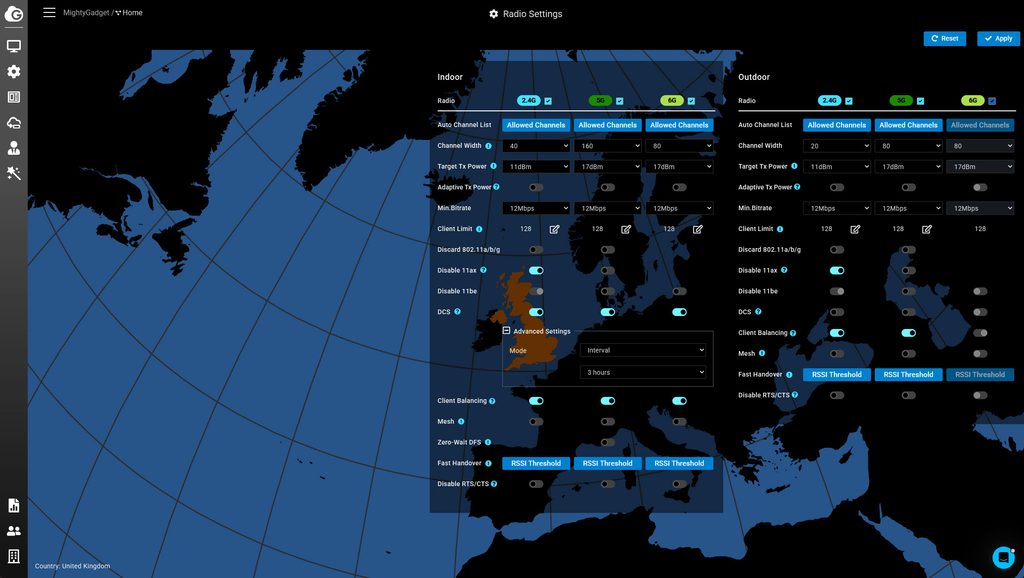
Radio Settings is the place you set the defaults for the entire community, with separate indoor and outside profiles. You’ll be able to set channel width, goal transmit energy, minimal bitrate, consumer restrict, dynamic channel choice (DCS) intervals, consumer balancing, mesh, zero-wait DFS and quick handover RSSI thresholds per band. For a house community with one or two APs, the defaults are effective. For a bigger deployment, the extent of management is on a par with UniFi and Omada.
Most of what a house consumer or small enterprise wants is included within the free Fundamental tier, which is among the stronger arguments for EnGenius over some rivals. A Professional licence unlocks longer log retention, topology views, extra detailed consumer troubleshooting and the directory-based captive portal choices. Within the UK, that has been quoted at round £57 per gadget for one yr or £136 for 3 years. That’s cheap for a enterprise, nevertheless it does add to the operating price, and UniFi doesn’t cost for equal options in the event you already personal a UniFi gateway.
My major criticism of the interface is that adjustments should not all the time on the spot. Making use of settings can take anyplace from a couple of seconds to a few minutes to achieve the AP, which may be irritating when you find yourself troubleshooting and need to see the impact of a change immediately.
Ethernet & PoE Passthrough
The wired ports are what make this AP price contemplating over a normal ceiling unit, in order that they deserve some clarification.
When the ECW515 is powered by PoE+, the two.5GbE port on the again is the uplink, and the 4 Gigabit ports on the underside behave like a small unmanaged change with cloud management. For those who energy the AP with a 54 V DC adaptor as an alternative, LAN2 can act as a non-PoE uplink, and the rear 2.5GbE port then works as a LAN port. That provides some flexibility if the cable within the wall just isn’t PoE succesful.
LAN5 supplies 802.3af PoE output, however the energy funds is proscribed. When the AP is itself powered by PoE+, LAN5 can provide as much as 7 W. That determine is smart when you think about that PoE+ delivers round 25.5 W on the gadget and the AP can draw as much as 18 W itself. Powering the AP from a 54 V DC adaptor raises the PoE output to fifteen W, which is the total 802.3af allowance. EnGenius doesn’t make this particularly apparent, and it determines what you may realistically plug in.
To check it, I related a Reolink TrackMix PoE digicam to LAN5. This can be a giant dual-lens PTZ digicam with motors, so it’s a pretty demanding gadget for a 7 W port. On the primary try, the digicam clearly acquired energy, because the PTZ mechanism moved, nevertheless it didn’t full its boot or seem within the Reolink app for a while. Connecting it on to my PoE change introduced it on-line rapidly, so I then moved it again to the ECW515. After a noticeably longer start-up, it totally booted, picked up an IP deal with, and each lenses streamed video with working PTZ management. As soon as operating, there was no lag or dropout within the feed.
So the PoE passthrough works, however it’s best suited to lower-power units. A hard and fast IP digicam, a VoIP telephone, a small sensor hub or one other low-power entry level can be nicely throughout the 7 W restrict. A PTZ digicam with IR illumination at evening is pushing it, and something rated above 7 W will want the AP to be on DC energy or a separate PoE supply.
The use case remains to be a superb one. In a storage or workshop, one cable run might present Wi-Fi for the room, wired ports for a bench PC or a printer, and energy for a digicam mounted exterior. With out the ECW515, that will usually imply a separate AP, a small PoE change and extra cabling.
The wired efficiency itself was effective. The Gigabit ports delivered full Gigabit speeds in my testing, and the two.5GbE uplink means the AP’s wi-fi site visitors doesn’t need to compete with the wired shoppers for a single Gigabit hyperlink again to the change. My one disappointment stays that the downstream ports are solely Gigabit. The UniFi U7 In-Wall and TP-Hyperlink EAP775-Wall each supply not less than one 2.5GbE downstream port, which is helpful for a NAS or a desktop with a multi-gig community card.
Wi-Fi Efficiency
Efficiency is respectable for the specs.
For five GHz 80 MHz, I achieved close-range speeds of as much as 915 Mbps when related utilizing WiFi 7 and 168 Mbps on 2.4 GHz 40 MHz.
Growing the 5 GHz channel width to 160 MHz let me attain 1,208 Mbps at shut vary, however it’s usually not advisable to make use of 160 MHz on 5 GHz until it’s the solely AP you might be utilizing.
To place these numbers into context, a 2×2 Wi-Fi 7 connection on an 80 MHz channel has a theoretical hyperlink price of round 1.4 Gbps, so 915 Mbps is roughly what you’d anticipate as soon as overheads are taken into consideration. At 160 MHz, the theoretical price doubles to round 2.9 Gbps, and the 1,208 Mbps I measured is much less environment friendly as compared. Within the UK, 160 MHz channels on 5 GHz overlap with DFS channels, which may be vacated if radar is detected, and a single 160 MHz channel takes up a big share of the out there spectrum. With multiple AP, or neighbouring networks close by, 80 MHz is the higher alternative.
The two.4 GHz result’s modest. 2.4 GHz is congested in most UK houses, and utilizing a 40 MHz channel there hardly ever delivers a significant acquire whereas making interference with neighbouring networks extra probably. I would go away 2.4 GHz at 20 MHz and use it for IoT units and long-range protection quite than velocity.
My assessments have been run with MLO turned off. With MLO enabled, a appropriate Wi-Fi 7 consumer can hyperlink to each radios without delay. In apply, MLO throughout 2.4 GHz and 5 GHz is extra about resilience and latency than uncooked throughput, as the two.4 GHz hyperlink provides comparatively little bandwidth. The actual good thing about MLO comes when 5 GHz is paired with 6 GHz, which this AP can not do.
The default transmit energy is kind of conservative. The cloud dashboard confirmed 11 dBm on 2.4 GHz and 17 dBm on 5 GHz, nicely beneath the utmost of 21 dBm and 22 dBm, and it reported antenna features of three dBi and 4 dBi quite than the 5 dBi listed within the specification. Decrease energy is smart for dense deployments equivalent to resorts, the place you need every AP to cowl one room with out bleeding into the following. If you’re utilizing a single ECW515 to cowl a bigger space of a house, it’s price elevating the goal transmit energy within the radio settings.
Vary is in keeping with what you’d anticipate from a 2×2 wall plate AP. It’s designed to cowl a room or a small space of a house, and different critiques recommend a sensible protection of round 90 to 120 sq. metres. It’s not a substitute for a centrally positioned ceiling AP in a big home.
Stability was good throughout my testing, and I didn’t expertise any disconnections.
Value and Different Choices
As regular for EnGenius, the principle subject you have got within the UK is availability. So far as I can inform, this isn’t extensively out there within the UK or EU. Solwise, one of many few UK EnGenius resellers, has quoted round £187 together with VAT, however inventory seems to be restricted.
Within the US, it’s out there from engeniustech.com for $289, although it’s exhibiting as bought out on the time of writing. I used to be knowledgeable that the MSRP was simply $199 again in April; I’ll assume the value has jumped up because of the worth will increase in {hardware} and varied tariffs that the US retains imposing on issues.
The older Wi-Fi 6 ECW215, with two Ethernet ports, is offered for $179.
Compared, UniFi has the next:
- U7 In-Wall for $164 (£126 from the UK UniFi retailer) – Twin-band Wi-Fi 7, two 2.5GbE downstream ports, one with PoE out
- U7 Professional Wall for $219 (£168 within the UK) – Tri-band, no extra ports
- U6 In-Wall for £140 – Twin-band Wi-Fi 6, 1x GbE PoE output, 3x GbE ports
TP-Hyperlink has the Omada EAP775 for $200, which is tri-band Wi-Fi 7 with 2x 2.5G ports (1x PoE+/PoE++ in) plus 3x Gigabit ports (2x PoE out or 1x PoE+ out). Within the UK, the EAP775-Wall is round £173. TP-Hyperlink additionally has the dual-band EAP725-Wall, which is the closest like-for-like rival, with one 2.5G PoE enter, one 2.5G pass-through port and two Gigabit ports for round £125 to £135.
Towards that discipline, the ECW515 is dear. The U7 In-Wall is round £60 cheaper, helps 240 MHz channels on 5 GHz for the next 4.3 Gbps ranking, and has 2.5GbE downstream ports, although it solely has two of them. The EAP775-Wall prices barely much less and provides a 6 GHz band and two PoE out ports. The place the ECW515 holds its personal is in having 4 downstream ports, the SSID on LAN characteristic, and the truth that the cloud controller is hosted for you while not having a UniFi gateway or Omada controller.
General
If you’re already dedicated to EnGenius, the ECW515 is a pleasant utility entry level that works nicely in a house or small workplace the place it’s possible you’ll not have a number of Ethernet ports run to every room.
Efficiency is nice for the specs, and most of the people will discover 900 Mbps+ at shut vary greater than satisfactory for his or her WiFi wants. Nonetheless, the shortage of the 6 GHz band does imply you may’t simply obtain the multi-gig throughput Wi-Fi 7 is thought for.
For many who should not dedicated to a networking ecosystem, each UniFi and TP-Hyperlink Omada supply cheaper and arguably better-specced in-wall entry factors.
The strengths are clear. Setup is fast, the cloud platform provides extra management than most individuals will want with no subscription, and the 4 Gigabit ports with SSID on LAN make it a tidy approach so as to add wired and wi-fi entry to a room from a single cable. The PoE passthrough works, and in the best location it may prevent a separate change and injector.
The weaknesses are largely about worth. The downstream ports are restricted to Gigabit, the PoE output is restricted to 7 W until you add a DC adaptor, and there’s no energy adaptor or injector within the field. There may be additionally no significant native administration, so you might be reliant on the EnGenius cloud. UK availability is poor, and at round £187, it’s onerous to advocate over the U7 In-Wall or the TP-Hyperlink EAP725-Wall until you might be already operating an EnGenius community.
EnGenius ECW515 Entry Level Evaluate
75%
Abstract
The EnGenius ECW515 is a succesful dual-band Wi-Fi 7 wall plate entry level with a helpful four-port Gigabit change and PoE passthrough. It’s straightforward to deploy and nicely managed by means of EnGenius Cloud, and the SSID on LAN characteristic is a brilliant contact for hospitality and workplace use. Nonetheless, the shortage of 6 GHz, Gigabit-only downstream ports, a 7 W PoE output restrict and excessive UK pricing imply it makes probably the most sense for present EnGenius customers.
Execs
- 4 Gigabit ports plus a 2.5GbE PoE+ uplink
- PoE passthrough for a digicam, telephone or one other AP
- SSID on LAN applies wi-fi safety insurance policies to wired ports
- Fast QR code setup and a succesful free cloud tier
- Fanless and silent
- 5-year guarantee
Cons
- No 6 GHz band
- Downstream ports are Gigabit solely
- PoE output restricted to 7 W when the AP is PoE powered
- No PoE injector or energy adaptor included
- No standalone native administration
- Costly and onerous to search out within the UK

I’m James, a UK-based tech fanatic and the Editor and Proprietor of Mighty Gadget, which I’ve proudly run since 2007. Keen about all issues know-how, my experience spans from computer systems and networking to cellular, wearables, and sensible residence units.
As a health fanatic who loves operating and biking, I even have a eager curiosity in fitness-related know-how, and I take each alternative to cowl this area of interest on my weblog. My numerous pursuits enable me to deliver a singular perspective to tech running a blog, merging way of life, health, and the newest tech tendencies.
In my educational pursuits, I earned a BSc in Data Programs Design from UCLAN, earlier than advancing my studying with a Grasp’s Diploma in Computing.
I’m proud to share that Vuelio has constantly ranked Mighty Gadget as one of many high know-how blogs within the UK. With my dedication to know-how and drive to share my insights, I purpose to proceed offering my readers with participating and informative content material.
I work immediately with the businesses he critiques merchandise for or their chosen PR company.
For Social Media, you will discover me on:

